AI Detection Software Is Not the Solution
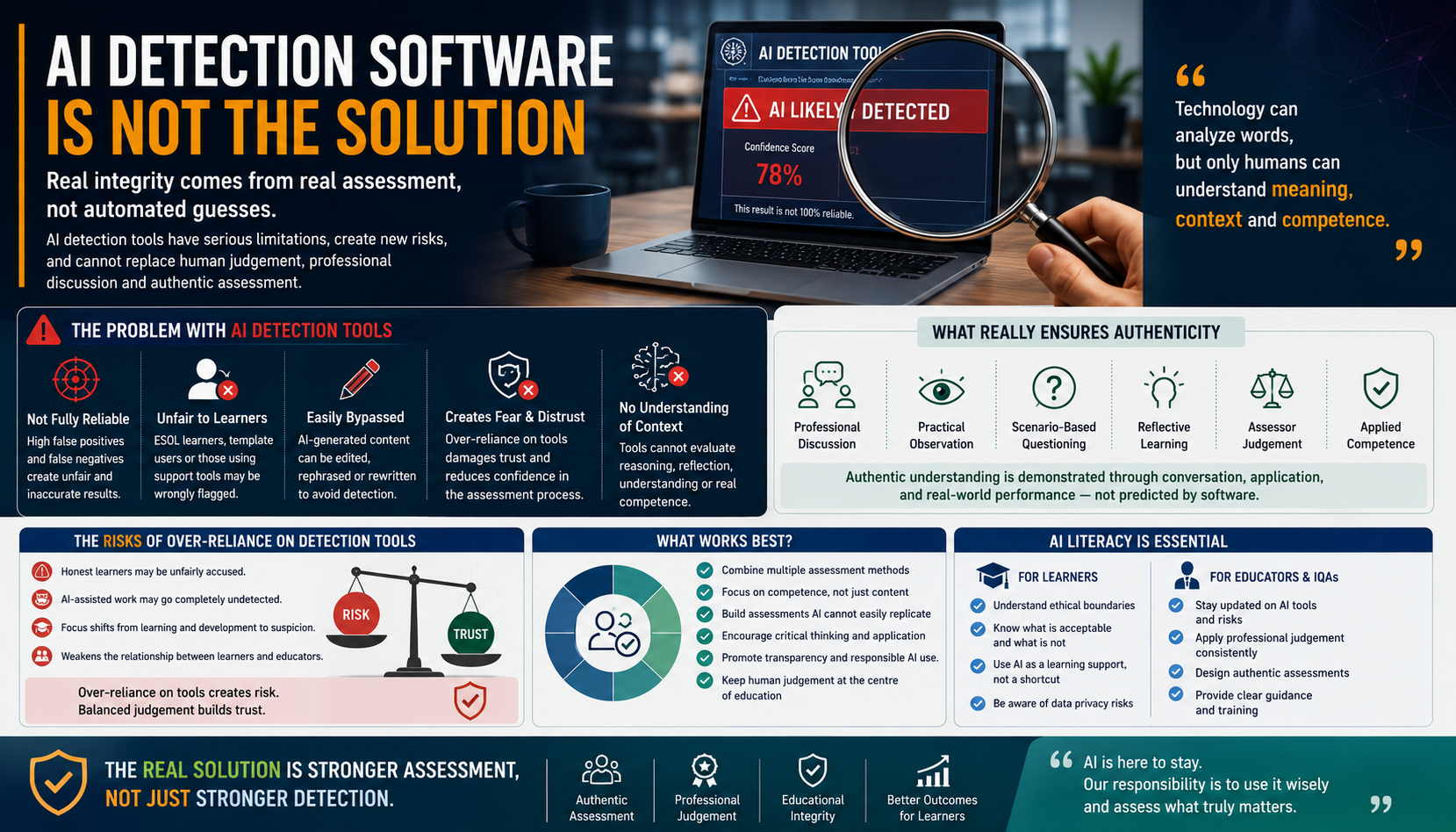
Real educational integrity does not come from automated guesses. It comes from authentic assessment, professional judgement, learner dialogue, and quality assurance systems that verify real competence.
Overview
As artificial intelligence becomes increasingly common in education, many schools, colleges, universities, and training providers are searching for ways to protect academic integrity and verify authentic learner work. In response, some organisations have turned towards AI detection software, hoping that technology can identify whether coursework has been generated by tools such as ChatGPT, Microsoft Copilot, Gemini, or other generative AI systems.
At first glance, this can appear to be a practical answer. It seems quick, technical, and reassuring. However, the reality is more complex. AI detection software is not a complete solution for educational integrity. In many cases, over-reliance on detection tools can create new problems for learners, educators, assessors, IQAs, and training providers.
The Problem with AI Detection Tools
One of the biggest challenges is reliability. Many AI detection systems claim to identify AI-generated writing by analysing sentence structure, predictability, language patterns, or writing consistency. However, these systems can produce false positives, where genuine learner work is incorrectly flagged as AI-generated.
This creates serious concerns about fairness, assessment validity, and learner confidence. For example, an ESOL learner may use formal academic language because they have learned English through textbooks, sentence models, or structured writing templates. A detection tool may incorrectly treat that polished structure as suspicious.
Learners may also be flagged unfairly when they use legitimate support, including:
- grammar and spelling tools,
- accessibility software,
- academic writing templates,
- translation support,
- or clear structured writing methods taught by their tutor.
The opposite problem also exists. AI-generated content can be edited, rewritten, personalised, or restructured before submission. In those cases, detection software may not identify AI involvement at all. Providers can quickly enter a weak cycle where honest work is flagged, AI-assisted work is missed, and confidence in the assessment process is damaged.
Key Point
Educational integrity cannot rely solely on automated detection systems. Detection may provide a signal, but it should never replace assessment design, professional discussion, practical evidence, and assessor judgement.
Authenticity Must Be Built Into Assessment Design
For many years, written assignments were treated as strong evidence of learner understanding. Producing a detailed piece of written work often suggested that the learner had researched, understood, organised, and explained the subject. Generative AI has changed that assumption. Learners can now produce convincing written responses in seconds, which means written evidence alone is no longer always enough to prove genuine competence.
The solution is not to make assessment more suspicious. The solution is to make assessment more authentic.
Authentic assessment allows learners to demonstrate:
- understanding,
- application of knowledge,
- critical thinking,
- reasoning,
- communication,
- reflection,
- and practical competence.
Professional discussion is one of the most effective methods for checking authenticity. For example, a cybersecurity learner may submit an excellent assignment on phishing, malware, and network security controls. The written work may look highly professional. However, during a professional discussion, the learner may struggle to explain how phishing emails are identified, what incident response steps should be followed, or why network segmentation improves security.
In that situation, the issue becomes clear through human conversation rather than software prediction. Professional discussion, workplace observation, scenario-based questioning, reflective learning, and practical demonstrations provide stronger evidence of genuine competence than written work alone.
The Risks of Over-Reliance
Impact on Learners
When organisations rely heavily on detection systems, learners may feel that they are constantly being monitored or accused. This can damage trust, reduce confidence, and create anxiety around legitimate support tools.
Impact on Educators
Educators and assessors may become over-dependent on technology instead of applying professional judgement. This is risky because assessment involves context, dialogue, evidence interpretation, and human understanding.
AI detection systems cannot fully evaluate learner confidence, practical competence, communication ability, reasoning, reflection, or professional judgement. These remain fundamentally human areas of assessment.
This does not mean AI detection tools have no value. In some cases, they may help identify unusual patterns or support risk-based quality assurance. However, they should only ever be used as one small part of a broader authenticity strategy.
What Works Better?
A stronger approach combines responsible AI governance with authentic assessment practice. Providers should not ask only, “Can we detect AI?” They should ask, “Can the learner explain, apply, justify, and demonstrate what they claim to know?”
Professional Discussion
Use structured questioning to verify understanding, reasoning, and the learner's ability to explain their own evidence.
Scenario-Based Tasks
Ask learners to apply knowledge to realistic situations where generic AI-generated answers are less useful.
Practical Evidence
Use observation, demonstrations, projects, presentations, and workplace evidence where appropriate.
Reflective Learning
Ask learners to explain what they did, why they did it, what changed, and what they would improve next time.
Assessor Judgement
Train assessors to interpret evidence holistically rather than relying on a single software score.
AI Literacy
Teach learners and staff the ethical boundaries, risks, acceptable use, and limitations of AI tools.
How This Can Be Implemented in Real Life
This article should not remain as theory. Training providers, assessors, IQAs, and education leaders can use the following practical approach to protect authenticity while still supporting fair and modern learning.
Step-by-Step Implementation Plan
- Review existing written assignments. Identify tasks where learners could submit generic AI-generated responses without proving real understanding.
- Add authenticity checks. Build in professional discussion, short oral questioning, learner reflection, or scenario-based follow-up questions.
- Update learner guidance. Explain what AI use is acceptable, what is not acceptable, and when learners must declare support tools.
- Train assessors. Make sure assessors understand that AI detection scores are not final evidence of misconduct.
- Strengthen IQA sampling. Include AI-related risks in sampling plans, especially for high-risk units, repeated templates, or unusually polished submissions.
- Use detection tools carefully. Treat detector results as a prompt for further review, not as automatic proof.
- Record decisions clearly. Keep evidence of professional discussion, assessor reasoning, IQA checks, and any learner clarification.
What Assessors Should Do
- Compare written work with learner discussion and practical performance.
- Ask follow-up questions where authenticity is unclear.
- Record professional judgement and evidence decisions.
- Avoid accusing learners based only on AI detection scores.
What IQAs Should Check
- Whether assessors are using consistent authenticity checks.
- Whether professional discussions are recorded properly.
- Whether AI concerns are handled fairly and proportionately.
- Whether assessment methods remain valid and reliable.
What Providers Should Implement
- A clear AI and assessment authenticity policy.
- Staff CPD on AI literacy and educational integrity.
- Learner guidance on acceptable AI use.
- A risk-based IQA sampling strategy.
Practical Example
A learner submits a written assignment that appears unusually polished. Instead of relying only on an AI detector, the assessor arranges a short professional discussion. The learner is asked to explain three key points from the assignment, apply the concept to a real scenario, and reflect on how they reached their conclusion. The assessor records the learner's responses and uses this alongside the written work to make a fair judgement. The IQA later samples the written evidence, the discussion record, and the assessor's decision-making notes.
Common Mistakes to Avoid
- Treating an AI detection percentage as proof of cheating.
- Using AI detection without a clear policy or learner guidance.
- Failing to consider ESOL learners, accessibility tools, or grammar support.
- Relying only on written assignments when practical competence is required.
- Not recording assessor decisions or IQA sampling outcomes.
Simple Action Plan
- Choose one high-risk assignment this week.
- Add three professional discussion questions.
- Add one scenario-based follow-up task.
- Create a short authenticity record form.
- Ask the IQA to sample the new process and provide feedback.