How AI Can Support Learners With Additional Learning Needs
and Language Barriers
Artificial Intelligence can improve accessibility, strengthen learner confidence, reduce communication barriers, and support more inclusive educational environments when used ethically and responsibly.
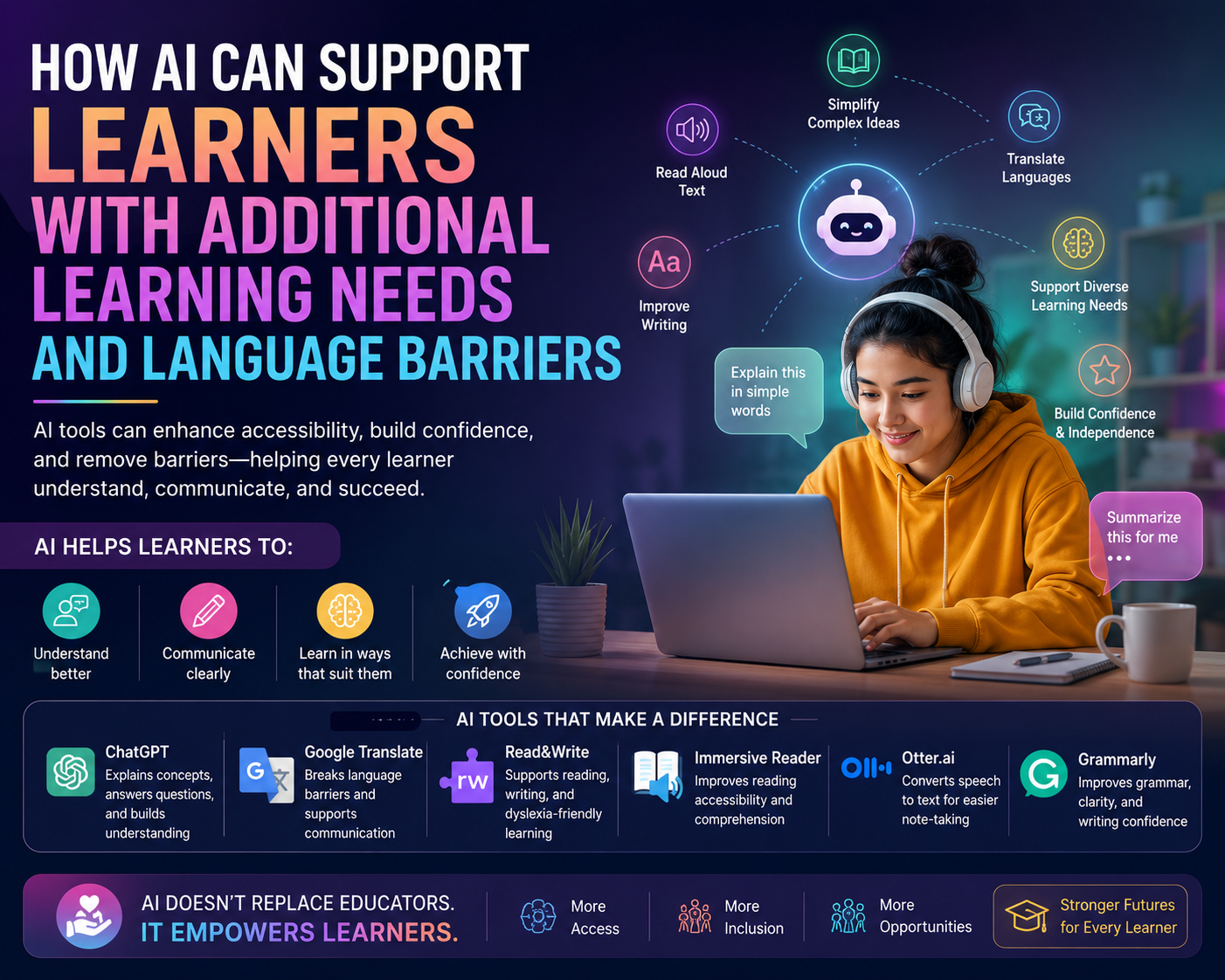
AI and Inclusive Education
Modern classrooms and training environments are increasingly diverse. Educators now work with learners from different cultural backgrounds, language groups, educational experiences, and learning abilities.
Some learners may have additional learning needs such as dyslexia, ADHD, literacy difficulties, processing challenges, or communication barriers, while others may struggle because English is not their first language.
Artificial Intelligence is increasingly helping educational providers create more accessible, supportive, and learner-centred environments.
How AI Can Help Learners
- Improve communication
- Support reading and writing
- Reduce language barriers
- Build learner confidence
- Improve accessibility
Useful AI Support Tools
- ChatGPT
- Google Translate
- Read&Write
- Immersive Reader
- Otter.ai & Speechify
Why It Matters
- Promotes inclusion
- Supports independence
- Reduces anxiety
- Encourages participation
- Strengthens understanding
Supporting Learners With Language Barriers
Many ESOL learners and international students understand concepts well but struggle to express themselves confidently in written English.
AI-powered writing tools can help:
- improve grammar and spelling,
- simplify sentence structure,
- explain difficult terminology,
- and provide clearer wording suggestions.
AI Can Help Learners Focus More On:
- demonstrating understanding,
- building confidence,
- participating in learning,
- and communicating ideas more effectively.
Translation tools such as Google Translate and DeepL can also help learners understand instructions, learning materials, and technical vocabulary more confidently.
Supporting Learners With Additional Learning Needs
AI can also provide valuable accessibility support for learners with dyslexia, reading difficulties, concentration challenges, processing difficulties, and other additional learning needs.
Examples of Accessibility Support
- Text-to-speech tools
- Speech-to-text systems
- Simplified explanations
- Visual learning support
- Automated summaries
Benefits for Learners With Dyslexia
- Improves readability
- Helps structure ideas
- Breaks tasks into sections
- Reduces anxiety
- Supports independent learning
Benefits for Learners With ADHD
- Shorter explanations
- Focused summaries
- Revision flashcards
- Step-by-step guidance
- Improved engagement
Personalised and Differentiated Learning
Traditionally, providing highly personalised support for every learner has been extremely time-consuming for educators.
AI tools can now help generate:
- alternative explanations,
- visual examples,
- simplified content,
- step-by-step breakdowns,
- and differentiated learning activities.
This type of reinforcement can improve learner independence and reduce barriers to understanding.
AI Does Not Replace Educators
Human support remains essential for motivation, safeguarding, emotional understanding, encouragement, and professional educational judgement.
The Importance of Human Support
Educators, assessors, mentors, and learning support staff continue to play a critical role in:
- building learner confidence,
- adapting teaching approaches,
- providing encouragement,
- monitoring progress,
- and supporting emotional wellbeing.
AI lacks the empathy, emotional intelligence, safeguarding awareness, and contextual understanding required to replace human educational support fully.
Risks and Important Considerations
While AI offers major opportunities, educational providers must also manage important risks carefully.
- AI can produce inaccurate information.
- Over-reliance may reduce independent thinking.
- Learners must verify AI-generated content critically.
- Data protection and safeguarding remain essential.
Learners increasingly require AI literacy so they understand:
- when to use AI,
- when not to use AI,
- how to verify information,
- and how to use AI ethically and responsibly.
How Educational Providers Can Apply This in Real Life
- Provide AI accessibility guidance for staff and learners.
- Support responsible AI usage policies.
- Use accessibility tools to improve inclusion.
- Encourage personalised learning support.
- Protect safeguarding and data privacy.
- Balance AI support with human guidance.
- Train learners in AI literacy and ethical use.
- Promote inclusive and learner-centred education.
Conclusion
When used ethically and responsibly, Artificial Intelligence has the potential to improve accessibility, reduce communication barriers, strengthen learner confidence, and support more inclusive education.
Ultimately, AI should be viewed as a support tool rather than a replacement for educators. The most effective learning environments will likely combine responsible AI use with strong human teaching, inclusive practice, and professional educational judgement.