Human Judgement Still Matters
in AI-Assisted Education
AI can provide information and automate processes, but authentic education still depends on human understanding, professional judgement, ethical reasoning, and real-world educational experience.
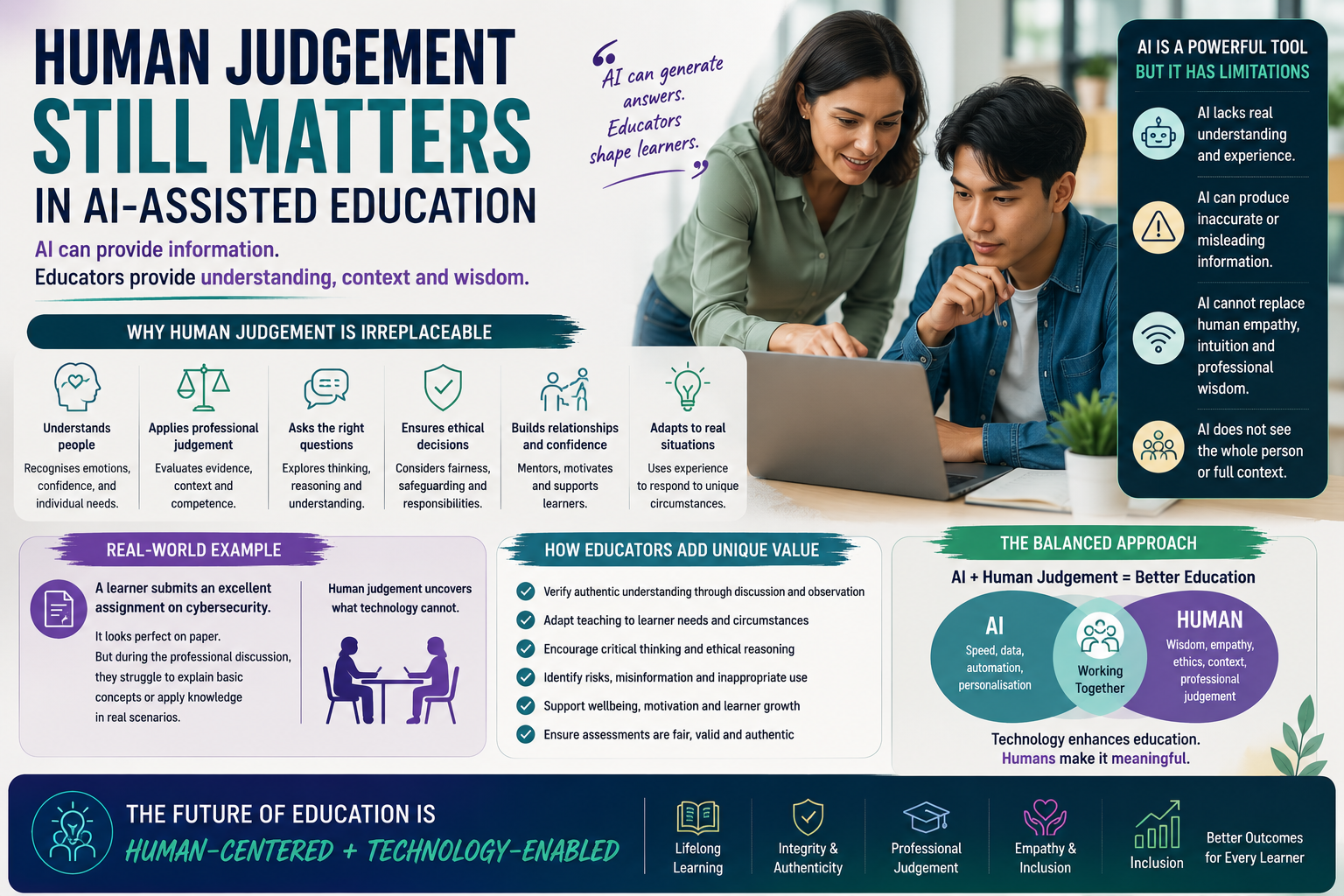
Why Human Judgement Remains Essential
Artificial Intelligence is rapidly becoming part of modern education. Across schools, colleges, universities, and vocational training environments, AI-powered systems such as ChatGPT, Microsoft Copilot, and Gemini are increasingly being used to support lesson planning, learner research, accessibility, assessment preparation, and administrative tasks.
At the same time, learners are using AI tools daily to summarise information, improve written work, generate revision materials, explain difficult concepts, and support independent study.
One of the biggest misconceptions surrounding AI is the assumption that education is simply about providing information. Effective education requires understanding people, recognising individual learner needs, adapting communication styles, evaluating competence, supporting confidence, and applying professional judgement in complex situations.
What AI Can Do
- Generate information quickly
- Support accessibility
- Assist with revision
- Automate repetitive tasks
- Provide learning guidance
What Educators Provide
- Professional judgement
- Emotional intelligence
- Mentoring and motivation
- Ethical reasoning
- Contextual understanding
Why This Matters
- Authentic competence verification
- Fair and valid assessment
- Support for learner wellbeing
- Professional accountability
- Real-world application of knowledge
The Authenticity Challenge
A learner may submit an assignment that appears academically strong and professionally written. However, during professional discussion or practical assessment, the same learner may struggle to explain key concepts, apply knowledge practically, justify decisions, or demonstrate occupational competence in realistic scenarios.
This is where human judgement becomes essential.
Why Professional Discussions Matter
- Explore learner understanding
- Assess confidence and reasoning
- Verify practical competence
- Evaluate decision-making ability
- Identify authentic understanding
- Support reflective learning
Human Judgement in Real Educational Practice
Experienced educators, assessors, and IQAs possess contextual understanding that AI systems currently cannot replicate effectively. They understand learner behaviour, communication patterns, confidence levels, safeguarding concerns, workplace expectations, and practical application of knowledge.
Assessment & IQA
- Verify authentic competence
- Apply balanced professional judgement
- Use evidence triangulation
- Support fair assessment decisions
Teaching & Learning
- Adapt teaching approaches
- Recognise emotional context
- Support disengaged learners
- Encourage critical thinking
Ethical Responsibilities
- Challenge misinformation
- Promote responsible AI usage
- Support safeguarding
- Maintain educational integrity
The Balanced Future of Education
The future of education is unlikely to involve AI replacing educators entirely. Instead, the future will likely involve collaboration between AI systems and educational professionals.
AI may assist with information delivery and administrative support, but educators will continue to play a critical role in mentoring learners, evaluating competence, supporting wellbeing, encouraging critical thinking, and maintaining educational integrity.
How Educational Providers Can Apply This in Real Life
- Strengthen authentic assessment methods.
- Increase professional discussions and observation activities.
- Train staff in AI literacy and ethical AI usage.
- Use AI responsibly as a support tool rather than a replacement.
- Maintain human oversight in assessment and quality assurance.
- Promote critical thinking and information verification skills.
- Ensure assessment decisions remain evidence-based and fair.
Conclusion
Artificial Intelligence may continue transforming how education is delivered and supported, but human judgement remains essential in ensuring that learning remains authentic, meaningful, fair, and professionally relevant.
Technology may enhance education, but it is still people who guide, inspire, evaluate, and shape the learning journey itself.