The Biggest Mistake
Educational Providers Are Making About AI
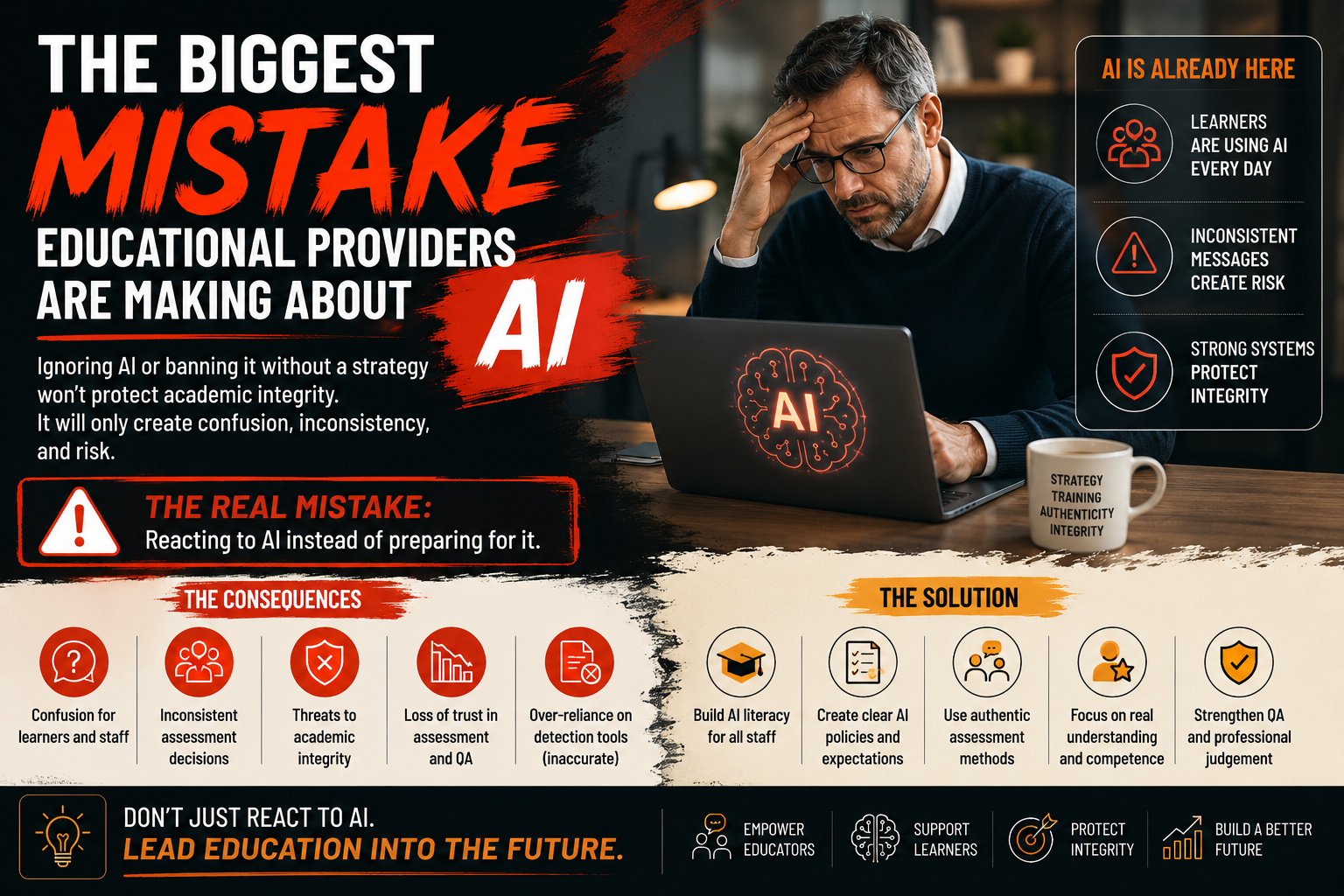
Ignoring AI or attempting to ban it without a clear strategy will not protect educational integrity. It will only create inconsistency, confusion, and risk across modern education.
Why This Mistake Matters
Artificial Intelligence is rapidly becoming part of everyday education. Across schools, colleges, universities, and vocational training environments, learners are increasingly using AI-powered tools such as ChatGPT, Microsoft Copilot, and Gemini to support research, generate ideas, improve written work, and assist with learning activities.
At the same time, educators are exploring how AI can support lesson planning, learner engagement, accessibility, assessment preparation, and administrative efficiency.
Many educational organisations are currently making one major mistake: they are either attempting to ignore AI completely or trying to ban it without developing realistic strategies for responsible use.
This approach is becoming increasingly unrealistic because AI technologies are now widely accessible, easy to use, and rapidly improving.
What Happens When AI Is Ignored
- Confusion for learners and staff
- Inconsistent assessment decisions
- Lack of governance and guidance
- Reduced confidence in QA systems
- Fear-driven responses to technology
What Learners Are Already Doing
- Using AI for revision support
- Improving written work
- Researching concepts
- Generating learning materials
- Accessing instant explanations
What Providers Actually Need
- Clear AI policies
- Staff AI literacy
- Authentic assessment methods
- Professional judgement
- Balanced governance frameworks
The Problem With Mixed Messages
One assessor may allow learners to use AI for grammar support and research assistance, while another may treat any AI involvement as academic misconduct. Without clear organisational guidance, learners receive mixed messages regarding what is acceptable and what is not.
This inconsistency can quickly undermine confidence in assessment and quality assurance processes.
The Real Solution
- Build AI literacy for all staff
- Create responsible AI policies
- Strengthen authentic assessment
- Use professional discussions and observation
- Focus on competence rather than polished text alone
- Promote ethical AI usage
- Support balanced educational leadership
Why Detection Tools Alone Are Not Enough
Many educational providers are becoming overly reliant on AI detection software despite growing concerns regarding accuracy and false positives. Genuine learner work can sometimes be incorrectly flagged as AI-generated, while heavily edited AI-assisted content may go undetected altogether.
Instead of relying solely on AI detection systems, providers should focus on strengthening authentic assessment practices.
Better Assessment Approaches
- Professional discussions
- Scenario-based questioning
- Practical demonstrations
- Workplace observations
- Reflective practice
- Holistic evidence gathering
Why Authenticity Matters
- Verifies genuine understanding
- Reduces over-reliance on written work
- Supports occupational competence
- Strengthens educational integrity
- Improves learner engagement
What Strong QA Looks Like
- Balanced professional judgement
- Risk-based IQA strategies
- Consistent standardisation
- Transparent assessment decisions
- Staff confidence and CPD
The Importance of AI Literacy
Another major mistake is failing to invest in AI literacy for staff. Many educators, assessors, and IQAs are now expected to manage AI-related challenges without receiving sufficient training or guidance.
Educational providers should prioritise:
- AI awareness training,
- ethical AI guidance,
- staff standardisation,
- responsible use policies,
- and ongoing CPD.
The Balanced Future of Education
AI itself should not automatically be viewed as a threat. In many situations, it can improve accessibility, inclusion, learner support, and operational efficiency when implemented responsibly.
The most effective approach lies in balanced integration supported by:
- professional judgement,
- ethical governance,
- authentic assessment,
- AI literacy,
- and strong human educational practice.
How Educational Providers Can Apply This in Real Life
- Create clear AI governance policies.
- Train staff on responsible AI usage.
- Increase authentic assessment activities.
- Reduce over-reliance on written evidence alone.
- Use professional discussions more regularly.
- Review assessment design for authenticity risks.
- Strengthen IQA and standardisation processes.
- Promote ethical and transparent AI usage.
Conclusion
Artificial Intelligence is already changing education. The question is no longer whether educational providers should respond to AI, but whether they are prepared to adapt responsibly while still protecting authenticity, fairness, competence, and educational integrity.
The biggest mistake educational providers can make is reacting to AI emotionally instead of preparing for it strategically.