The Future of Quality Assurance
in the Age of AI
Artificial Intelligence is transforming education rapidly, but strong quality assurance remains essential for protecting authenticity, fairness, competence, and the long-term value of qualifications.
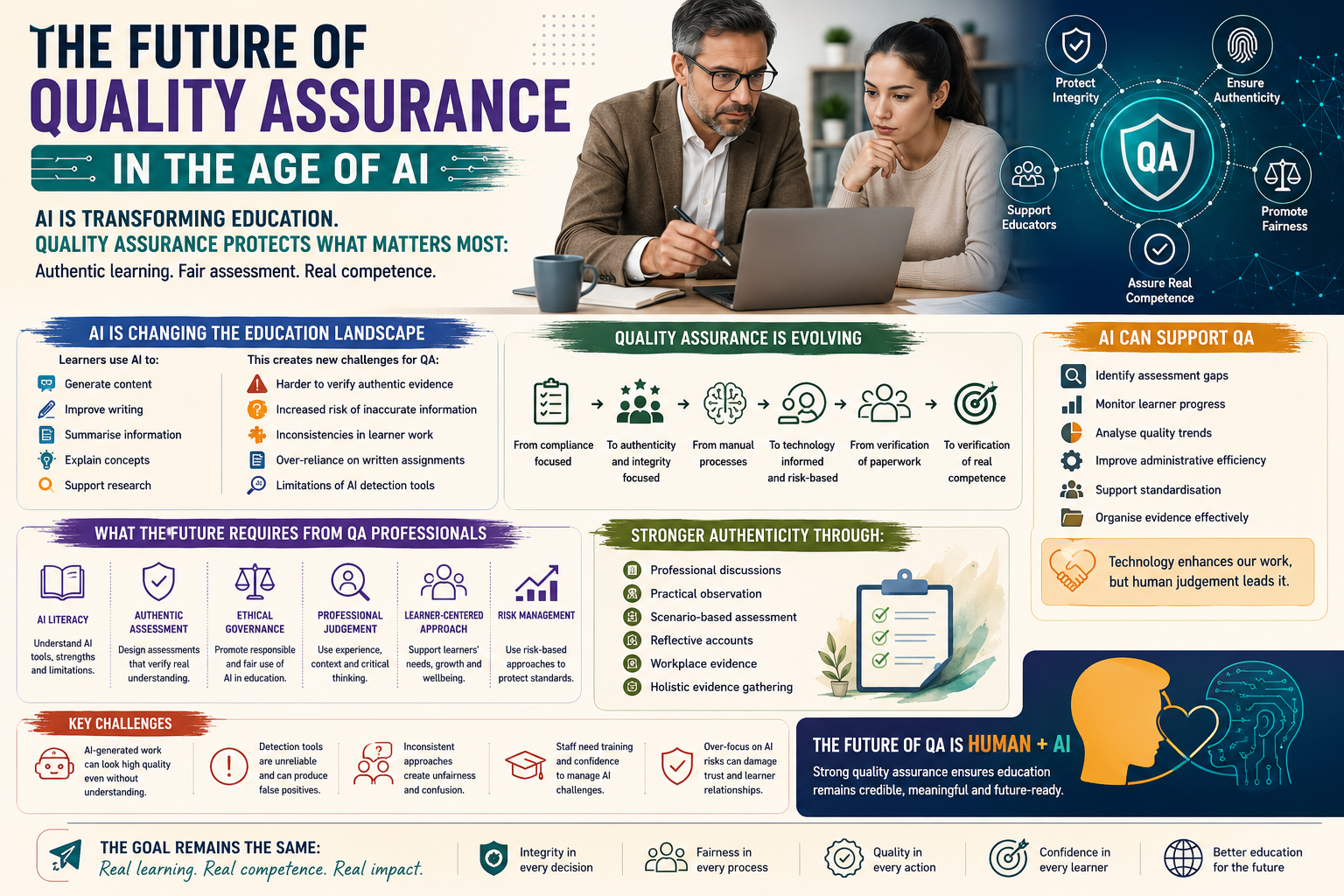
Why Quality Assurance Is Evolving
Artificial Intelligence is rapidly changing the educational landscape. Across schools, colleges, universities, and vocational training environments, AI-powered systems such as ChatGPT, Microsoft Copilot, and Gemini are increasingly influencing how learners study, how educators teach, and how assessment evidence is created.
As this transformation continues, educational institutions are facing an important challenge:
Historically, Internal Quality Assurance focused heavily on assessment consistency, compliance, sampling, documentation, standardisation, and verification of assessment decisions.
While these responsibilities remain essential, the rise of AI is significantly expanding the role of educational quality assurance.
Traditional QA Focus
- Assessment consistency
- Compliance monitoring
- Sampling and verification
- Documentation checks
- Standardisation activities
Modern QA Priorities
- Authenticity verification
- Ethical governance
- AI literacy
- Risk management
- Assessment validity
Why This Matters
- Protects qualification credibility
- Supports learner fairness
- Maintains authentic competence
- Strengthens educational trust
- Supports future-ready education
The Authenticity Challenge
Today, learners can use AI systems to generate assignments, improve academic writing, summarise information, create technical explanations, and structure responses professionally.
In many situations, AI-generated work can appear academically strong even when the learner has limited understanding of the subject itself.
Why Authentic Assessment Is Becoming Essential
- Professional discussions
- Practical observation
- Reflective learning
- Scenario-based assessment
- Workplace evidence
- Holistic evidence gathering
These approaches allow quality assurance professionals to evaluate learner understanding more effectively while reducing over-reliance on polished written submissions alone.
Risk-Based Quality Assurance
Modern IQAs increasingly need to monitor additional authenticity risks such as:
- sudden changes in learner writing style,
- generic AI-generated responses,
- inconsistencies between written evidence and observed competence,
- limited learner engagement during professional discussions,
- and unrealistic academic language patterns.
This does not mean educational providers should automatically assume misconduct whenever AI is suspected. Overly aggressive approaches may create unfairness, distrust, and fear-driven learning environments.
The Need for AI Literacy
Another critical challenge facing the sector is the growing need for AI literacy among educational professionals.
Many assessors, tutors, and IQAs are now expected to manage AI-related challenges without receiving sufficient training or guidance.
Why Staff Training Matters
- Improves assessment confidence
- Reduces inconsistency
- Supports ethical AI use
- Strengthens governance
- Improves learner support
What Future Providers Will Invest In
- AI literacy training
- Authentic assessment design
- Ethical AI guidance
- Staff standardisation
- Responsible governance frameworks
What Happens Without CPD
- Inconsistent staff decisions
- Fear-driven responses
- Reduced assessment confidence
- Weak governance structures
- Learner confusion
How AI Can Positively Support QA
Artificial Intelligence itself may also support quality assurance operations positively when used responsibly.
AI-assisted systems may help educational providers:
- identify assessment gaps,
- monitor learner progress,
- improve administrative efficiency,
- analyse quality trends,
- support standardisation activities,
- and organise evidence tracking more effectively.
For example, AI may help identify incomplete mapping across assessment criteria or highlight inconsistencies in feedback patterns across learner groups.
Technology Supports QA - Humans Lead It
AI systems may process information efficiently, but human judgement remains essential because educational quality assurance involves ethics, fairness, communication, safeguarding, professional understanding, and interpretation of human behaviour.
The Future of Quality Assurance
The future of quality assurance will likely involve collaboration between technology and human expertise rather than complete automation.
Educational organisations that succeed in the future are unlikely to be those that simply adopt the most advanced AI tools. Success will belong to institutions that combine:
- responsible AI usage,
- authentic assessment,
- ethical governance,
- strong professional judgement,
- learner-centred support,
- and robust quality assurance systems.
How Educational Providers Can Apply This in Real Life
- Strengthen authentic assessment methods.
- Increase professional discussions and observation activities.
- Develop AI governance frameworks.
- Provide ongoing AI literacy CPD for staff.
- Use balanced professional judgement.
- Reduce over-reliance on written evidence alone.
- Strengthen standardisation and risk-based IQA.
- Use AI responsibly to support operational efficiency.
Conclusion
Artificial Intelligence will continue transforming education rapidly, but strong quality assurance remains essential for protecting fairness, authenticity, learner credibility, and the long-term value of qualifications themselves.
The future of QA is not about resisting technology entirely. It is about ensuring education continues to measure genuine understanding, competence, critical thinking, and professional capability within increasingly digital learning environments.