The Rise of Authentic Assessment
in the Age of AI
Artificial Intelligence can generate information in seconds, but authentic assessment remains essential for verifying real understanding, critical thinking, competence, and practical application of knowledge.
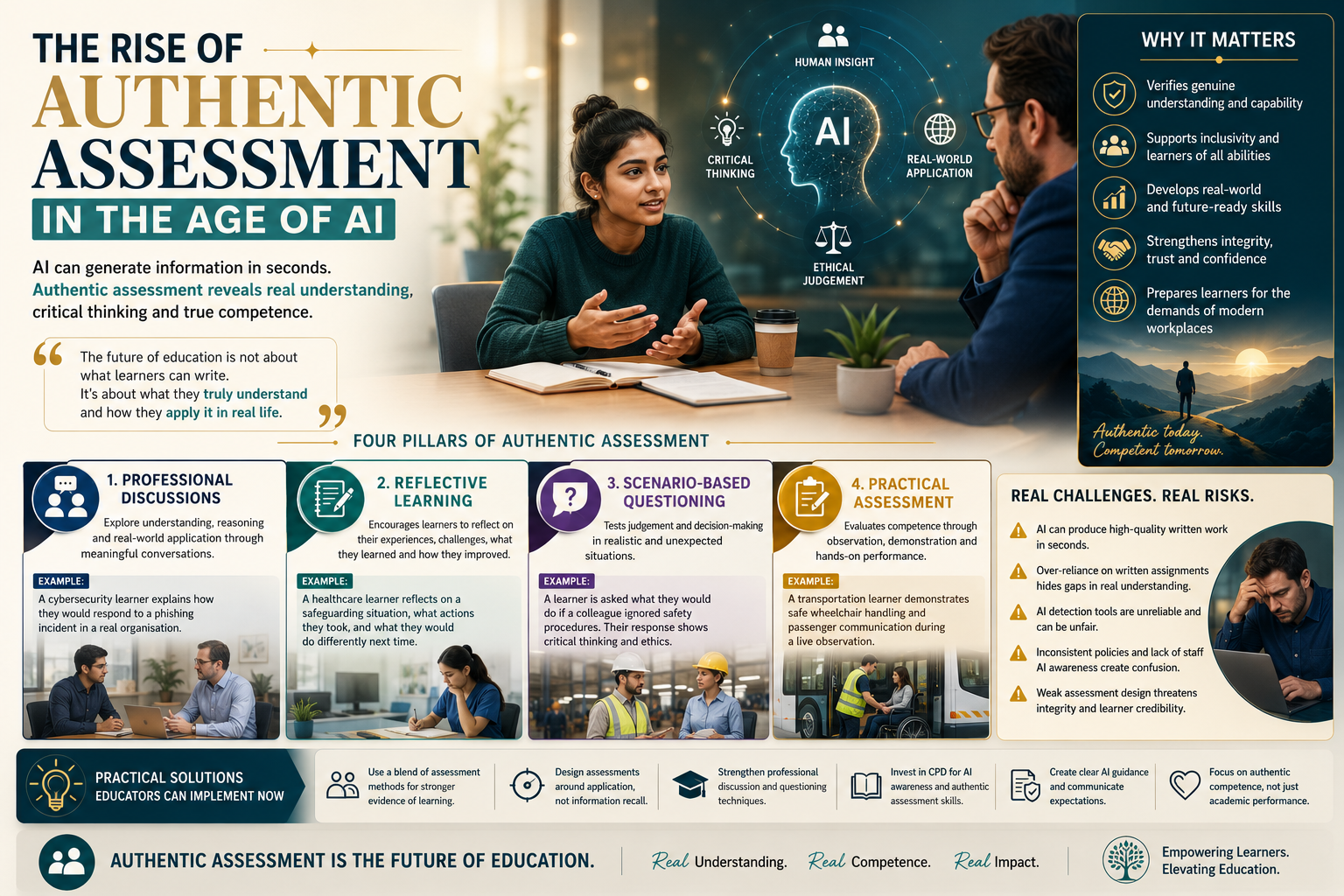
Why Authentic Assessment Matters More Than Ever
Artificial Intelligence is rapidly transforming education across schools, colleges, universities, and vocational training environments. Learners now have access to AI-powered tools such as ChatGPT, Microsoft Copilot, and Gemini that can generate written responses, explain concepts, summarise information, and support coursework within seconds.
While these technologies create significant opportunities for accessibility and learning support, they are also creating one of the biggest assessment challenges modern education has faced in years.
For many years, written assignments formed a major part of assessment across education. In most cases, strong written work was often treated as reliable evidence of learner competence and understanding.
However, generative AI has changed this environment dramatically.
What AI Can Do
- Generate polished coursework
- Summarise information quickly
- Improve grammar and structure
- Support accessibility
- Assist with research and revision
The Assessment Problem
- Written work may not reflect real understanding
- Competence becomes harder to verify
- Over-reliance on coursework creates risk
- AI detection tools remain unreliable
- Authenticity becomes harder to measure
What Authentic Assessment Measures
- Critical thinking
- Real-world application
- Decision-making ability
- Communication and reasoning
- Practical competence
Why Written Coursework Alone Is No Longer Enough
A learner may submit a technically advanced assignment discussing cybersecurity threats, healthcare safeguarding, transportation safety, or engineering procedures. The written work may appear highly professional on paper.
However, during professional discussion or practical observation, the learner may struggle to explain how knowledge applies within realistic workplace situations.
Authentic Assessment Focuses On:
- Professional discussions
- Scenario-based questioning
- Reflective learning
- Practical demonstration
- Observation of competence
- Applied workplace evidence
These methods allow educators and assessors to evaluate learner understanding far more effectively than relying solely on written assignments.
The Growing Importance of Professional Discussion
Professional discussion is becoming one of the most valuable assessment methods within AI-assisted education because it allows educators to explore:
- learner understanding,
- reasoning and communication,
- real-world application of knowledge,
- decision-making ability,
- and learner confidence.
Unlike static written evidence, discussions allow assessors to ask follow-up questions, clarify understanding, and evaluate how learners think within realistic situations.
Reflective Learning and Practical Assessment
AI systems may generate information quickly, but personal reflection remains much more difficult to automate meaningfully.
Reflective learning allows educators to evaluate:
- self-awareness,
- learner engagement,
- critical thinking,
- problem-solving ability,
- and genuine understanding.
Similarly, practical observation and demonstration activities help verify whether learners can apply knowledge safely, confidently, and competently within realistic environments.
Examples of Authentic Assessment
- Healthcare safeguarding scenarios
- Cybersecurity incident response discussions
- Transportation safety demonstrations
- Engineering problem-solving tasks
- Real workplace observations
Why These Methods Work
- Verify competence directly
- Support fairer assessment
- Reduce information reproduction
- Promote learner confidence
- Encourage critical thinking
Who Benefits Most
- Vocational learners
- ESOL learners
- Learners with dyslexia
- Learners with additional needs
- Practical and workplace learners
The Problem With AI Detection Software
Many institutions initially believed AI detection systems would solve authenticity concerns. However, many AI detection tools remain unreliable and may produce false positives, inaccurate conclusions, and unfair outcomes.
ESOL learners, learners using grammar support tools, or learners following structured academic formats may sometimes be incorrectly flagged despite producing genuine work.
The Real Solution Is Stronger Assessment Design
Educational providers increasingly need balanced assessment systems that combine written evidence, professional discussion, practical observation, reflective learning, scenario-based questioning, and applied assessment methods.
The Need for Staff Development
Educators themselves increasingly require support and training to manage these changes effectively.
Continuous Professional Development in:
- AI awareness,
- authentic assessment design,
- professional questioning,
- and authenticity verification
is becoming increasingly important across modern education.
How Educational Providers Can Apply This in Real Life
- Strengthen professional discussion activities.
- Increase observation and demonstration-based assessment.
- Design assessments around application rather than memorisation.
- Reduce over-reliance on written coursework alone.
- Provide AI literacy and authenticity training for staff.
- Use reflective learning more consistently.
- Create balanced AI governance frameworks.
- Focus on genuine competence and real-world understanding.
Conclusion
Artificial Intelligence will continue transforming education rapidly, but authentic assessment remains essential for protecting educational integrity, learner credibility, qualification value, and genuine human understanding.
The future of education increasingly depends on whether learners can think critically, communicate effectively, solve problems, apply knowledge responsibly, and demonstrate competence within real-life situations.