Why AI CPD Is Becoming Essential
for Educators
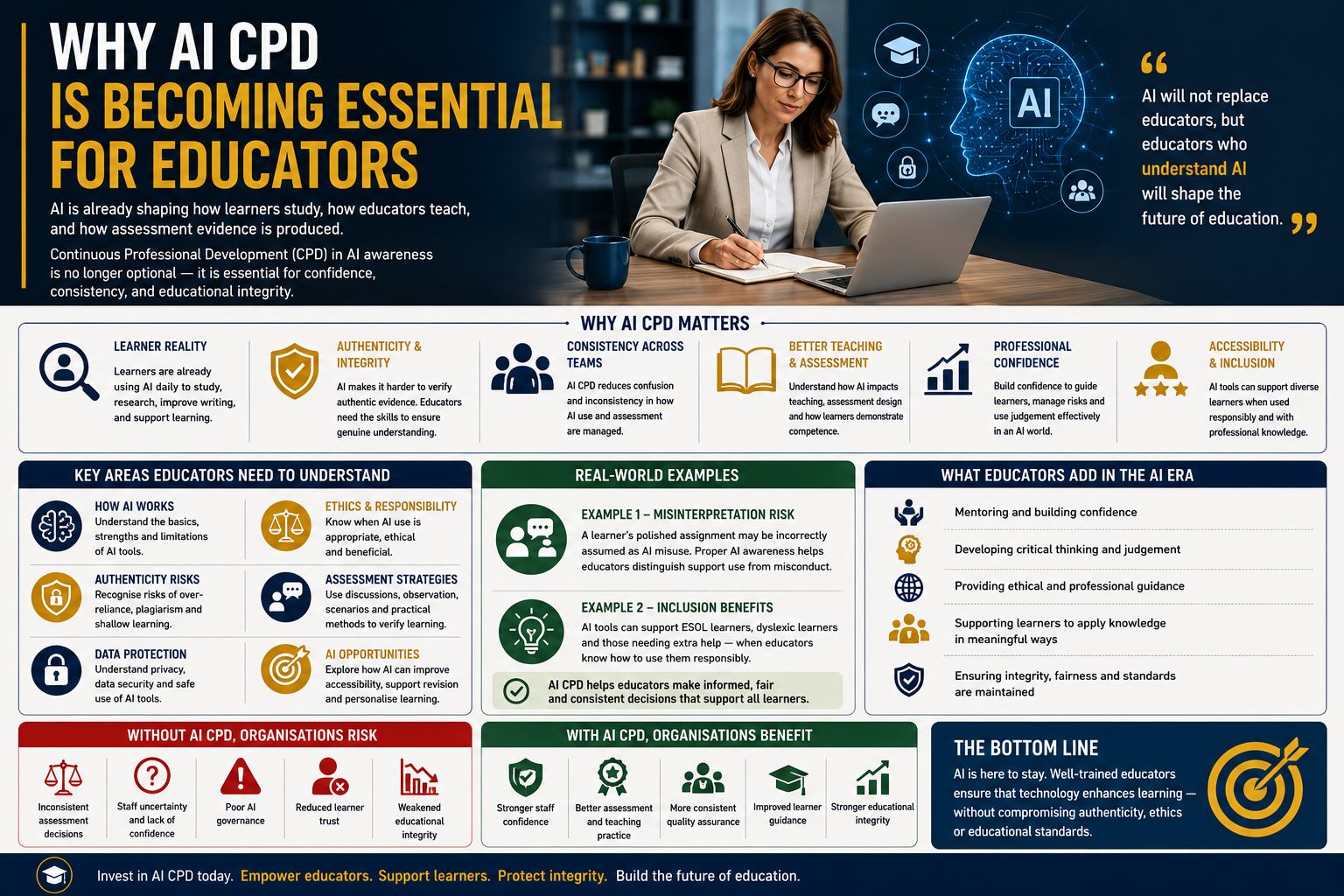
Artificial Intelligence is already shaping how learners study, how educators teach, and how assessment evidence is produced. AI awareness and Continuous Professional Development are no longer optional within modern education.
Why AI Awareness Is Now Essential
Artificial Intelligence is rapidly transforming education across schools, colleges, universities, and vocational training environments. Tools such as ChatGPT, Microsoft Copilot, and Gemini are increasingly influencing how learners study, how educators teach, and how assessment evidence is produced.
As a result, one important reality is becoming increasingly clear:
In many educational settings, learners are already using AI daily to generate ideas, improve written work, summarise information, revise content, explain difficult concepts, and support independent learning.
However, while learner adoption of AI continues growing rapidly, many educators are still trying to understand:
- how AI works,
- what risks it creates,
- how it affects assessment,
- and how it can be used responsibly within education.
Why AI CPD Matters
- Builds educator confidence
- Improves assessment consistency
- Strengthens authenticity verification
- Supports educational integrity
- Promotes responsible AI use
What Educators Need to Understand
- AI strengths and limitations
- Authenticity risks
- Ethical AI usage
- Assessment implications
- Accessibility opportunities
What Happens Without Training
- Inconsistent assessment decisions
- Reduced staff confidence
- Weak governance
- Confusion across teams
- Reduced learner trust
The Importance of Consistency Across Teams
Without proper AI awareness training, organisations risk inconsistency and uncertainty across teams and departments.
For example, one assessor may encourage responsible AI use for revision and grammar support, while another may treat any AI involvement as academic misconduct.
Similarly, some educators may rely too heavily on unreliable AI detection software, while others may ignore authenticity concerns completely.
AI CPD Helps Educators:
- Make informed assessment decisions
- Distinguish support from misconduct
- Use professional judgement confidently
- Design stronger authentic assessments
- Guide learners responsibly
- Support ethical AI usage
Understanding Authenticity Risks
Generative AI systems can produce inaccurate information, fabricated references, biased outputs, and misleading explanations while presenting information confidently as fact.
Learners who rely too heavily on AI without critical thinking may therefore develop shallow understanding or unknowingly reproduce incorrect information.
Professional discussions, reflective learning, scenario-based questioning, and practical assessment methods are becoming increasingly important because they help educators verify genuine learner understanding rather than relying solely on written assignments.
AI CPD and Educational Integrity
AI CPD also plays a major role in safeguarding educational integrity.
Many educational providers are still developing policies regarding:
- acceptable AI usage,
- assessment expectations,
- learner disclosure,
- data protection,
- and ethical boundaries.
Educators therefore require training not only in how AI works, but also when AI use is appropriate, when it becomes problematic, and how to guide learners responsibly.
Accessibility & Inclusion Benefits
- Supports ESOL learners
- Helps learners with dyslexia
- Improves accessibility
- Provides revision support
- Encourages independent learning
What Educators Add In The AI Era
- Mentoring and guidance
- Critical thinking development
- Professional judgement
- Ethical leadership
- Human understanding and support
Organisational Benefits of AI CPD
- Stronger staff confidence
- Better assessment practice
- More balanced governance
- Improved quality assurance
- Stronger educational integrity
AI Literacy as Professional Competence
The future of education is unlikely to focus purely on delivering information because learners can already access information instantly through AI systems.
Instead, educators increasingly add value through:
- mentoring,
- critical thinking development,
- ethical guidance,
- professional judgement,
- learner support,
- and helping learners apply knowledge meaningfully.
AI Will Not Replace Educators
However, educators who understand AI responsibly are increasingly likely to shape the future of modern education.
How Educational Providers Can Apply This in Real Life
- Provide AI awareness CPD for all staff.
- Create clear AI governance policies.
- Standardise assessment expectations.
- Train staff in authentic assessment methods.
- Strengthen professional discussion practices.
- Reduce over-reliance on written coursework alone.
- Support ethical and inclusive AI use.
- Promote balanced professional judgement.
Conclusion
Artificial Intelligence is no longer a future issue within education. It is already shaping classrooms, assessments, quality assurance processes, and learner behaviour right now.
Technology will continue evolving rapidly, but well-trained educators remain essential for ensuring that learning stays authentic, ethical, inclusive, and professionally meaningful within increasingly AI-assisted educational environments.