Why AI Training for IQAs & Assessors
Is No Longer Optional
Artificial Intelligence is changing how learners create, research, and submit evidence. IQAs and Assessors increasingly require AI awareness, authenticity verification skills, and professional confidence to protect assessment integrity.
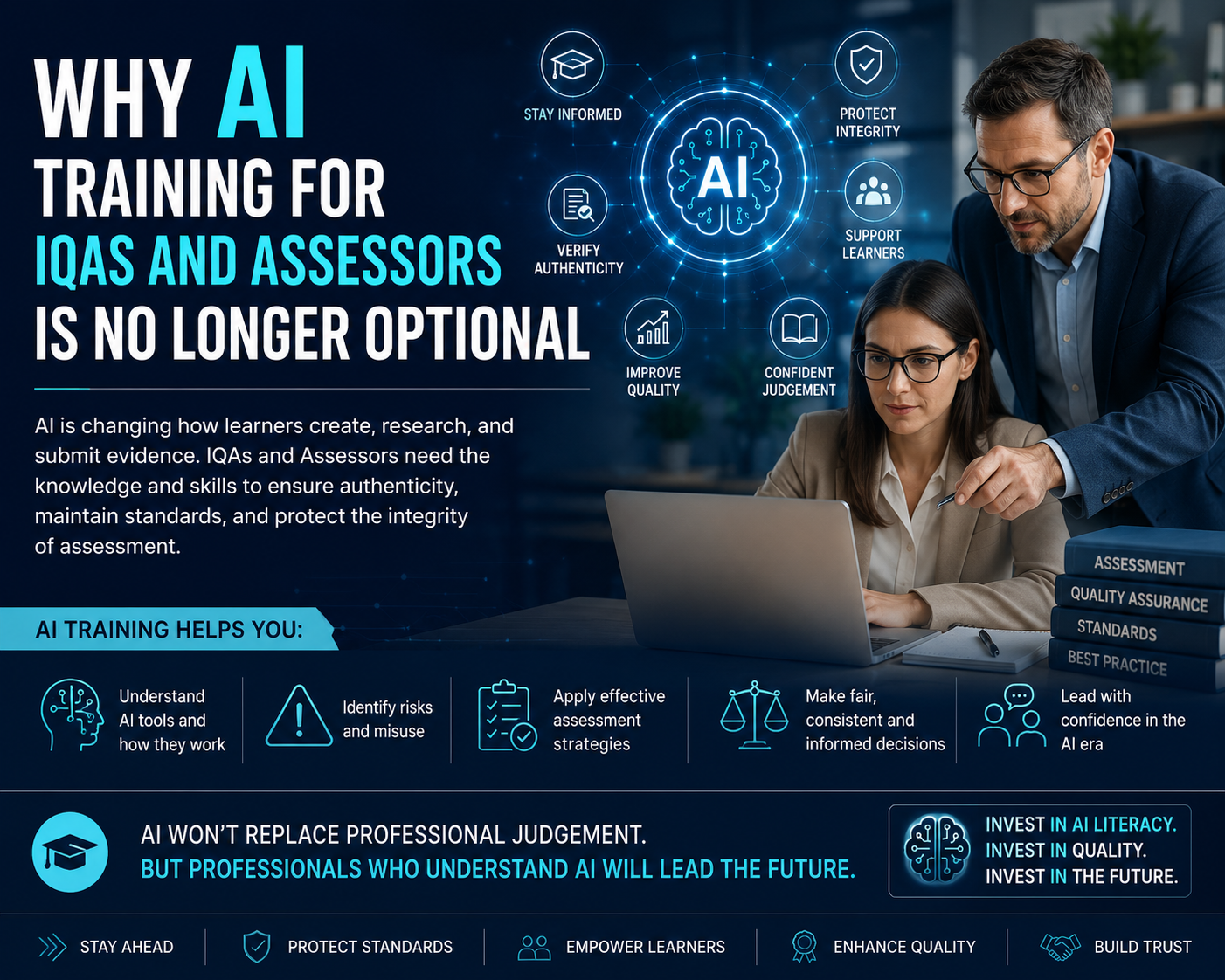
Why AI Awareness Matters for IQAs and Assessors
Artificial Intelligence is rapidly transforming education, assessment, and quality assurance across schools, colleges, universities, and vocational training environments.
Tools such as ChatGPT, Microsoft Copilot, and Gemini are increasingly being used by learners to generate written content, improve assignments, conduct research, and support learning activities.
While these technologies offer significant opportunities, they also create major challenges for assessors, Internal Quality Assurers (IQAs), and training providers responsible for maintaining assessment integrity and educational standards.
Learners can now produce highly structured and academically convincing responses within seconds, sometimes without fully understanding the content being submitted.
Why AI Training Is Essential
- Protects assessment integrity
- Supports authentic assessment
- Improves consistency
- Strengthens professional judgement
- Supports fair learner treatment
What Assessors Need To Understand
- How generative AI works
- AI strengths and limitations
- Authenticity risks
- AI governance expectations
- Responsible learner support
What Happens Without CPD
- Inconsistent assessment decisions
- Weak authenticity verification
- Staff uncertainty
- Reduced learner trust
- Poor governance practices
The Real Challenge Is Not Simply Detecting AI
In many situations, learners may use AI tools legitimately to improve grammar, structure, accessibility, or understanding of complex topics.
The real challenge lies in distinguishing responsible AI-assisted learning from situations where over-reliance on AI undermines assessment validity and authenticity.
Modern IQAs and Assessors Increasingly Need Skills In:
- Authenticity verification
- Critical questioning
- Professional discussion techniques
- AI-aware assessment design
- Ethical AI guidance
- Risk-based quality assurance
The Growing Importance of Authentic Assessment
Professional discussions, workplace observations, scenario-based questioning, and practical demonstrations are becoming increasingly important within AI-aware assessment environments.
These approaches allow assessors to explore learner understanding more deeply rather than relying solely on written submissions.
Examples of Authentic Assessment
- Professional discussion
- Practical observation
- Scenario-based tasks
- Reflective learning
- Workplace evidence
Benefits for Learners
- Fairer assessment opportunities
- Real-world competence focus
- Improved confidence
- Deeper learning engagement
- Better professional preparation
Benefits for Providers
- Stronger quality assurance
- Improved standardisation
- Reduced assessment risks
- Greater consistency
- Enhanced credibility
The Evolving Role of the IQA
Internal Quality Assurance is no longer limited to checking paperwork or confirming whether assessment criteria have technically been achieved.
Modern IQA practice increasingly involves:
- evaluating authenticity,
- reviewing holistic evidence,
- supporting standardisation,
- identifying emerging risks,
- and ensuring assessment decisions remain fair, consistent, and credible.
This represents a major shift in professional practice across modern education.
AI Itself Is Not The Problem
When used responsibly, AI can improve accessibility, reduce administrative workload, support learners with language barriers, assist with resource creation, and enhance educational efficiency.
The challenge is ensuring educational professionals have the training and confidence to manage AI responsibly and ethically.
The Importance of Governance and Standardisation
Another major challenge across the education sector is inconsistency.
Some assessors are highly confident using AI technologies, while others may have limited understanding of how these systems work.
Without proper CPD and standardisation, centres risk:
- inconsistent assessment practices,
- unfair learner treatment,
- unclear AI expectations,
- and reduced educational confidence.
How Educational Providers Can Apply This in Real Life
- Provide AI awareness CPD for assessors and IQAs.
- Strengthen authentic assessment methods.
- Increase professional discussion activities.
- Improve standardisation around AI usage.
- Create balanced AI governance policies.
- Train staff in authenticity verification.
- Reduce over-reliance on written evidence alone.
- Support ethical and inclusive AI use.
Conclusion
Artificial Intelligence is transforming assessment and quality assurance rapidly. Educational professionals who fail to develop AI awareness may increasingly struggle to maintain effective assessment and quality assurance practices within evolving digital learning environments.
AI training is therefore no longer an optional professional development activity for assessors and IQAs. It is becoming an essential requirement for protecting educational quality, maintaining assessment integrity, supporting learners responsibly, and ensuring qualifications continue to reflect genuine competence within the modern AI era.