Supporting Learners With ADHD Through AI Tools
For some learners, the hardest part of learning is not understanding the topic. It is getting started, staying focused and organising the steps.
Opening Hook
For some learners, the hardest part of learning is not understanding the topic. It is getting started, staying focused and organising the steps.
That is why AI tools could be useful for learners with ADHD when they are used as structure, not as a shortcut.
The opportunity is practical: clearer tasks, smaller steps, reminders and better routines.
Why This Matters
This matters because education often rewards organisation as if it were the same thing as ability.
A learner may have strong ideas but struggle with planning, attention, time management or task completion. AI can help break large tasks into manageable stages, create checklists, generate reminders and support independent study routines.
Used well, AI can help learners build habits. Used poorly, it can become another distraction.
Key Point
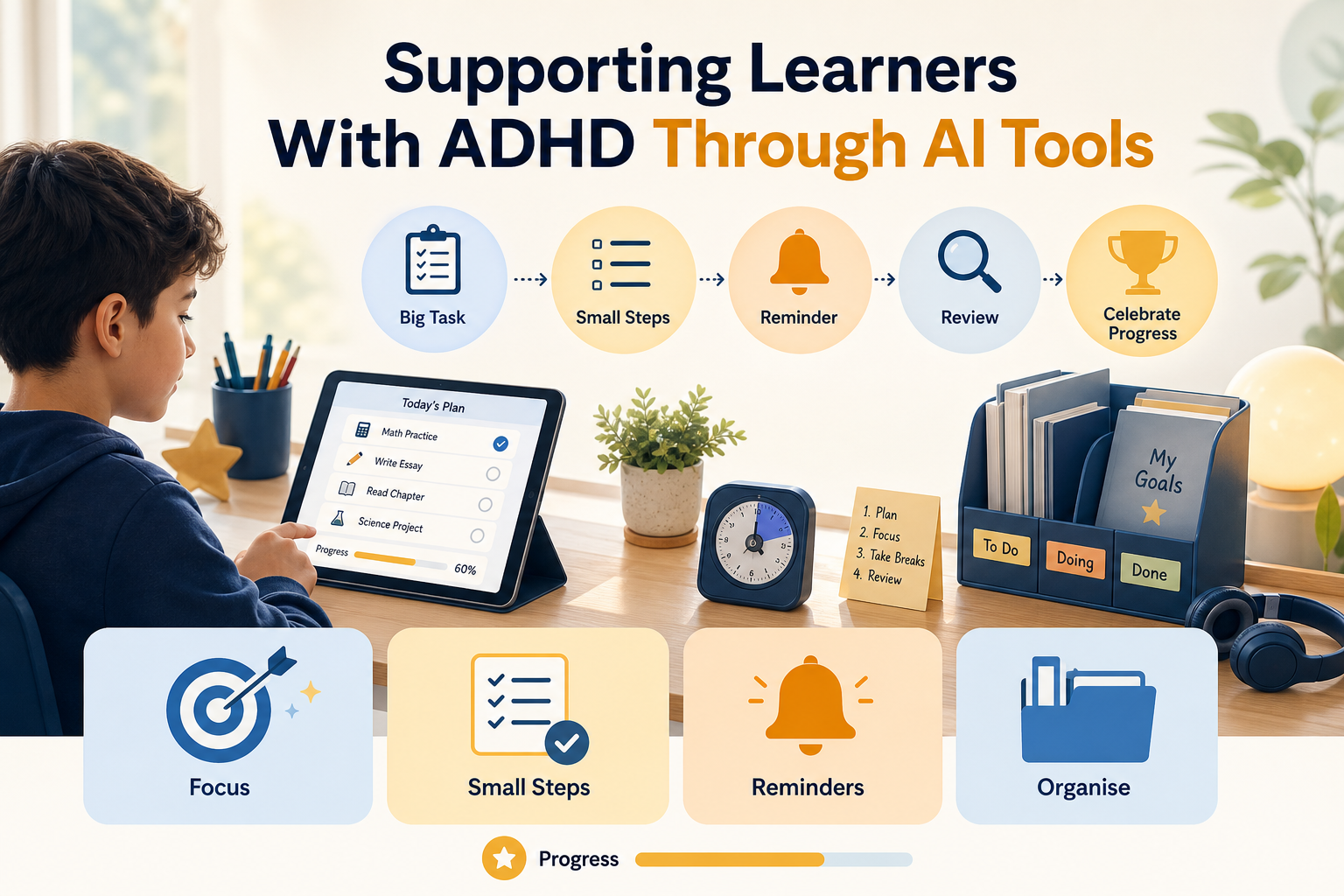
AI tools can support learners with ADHD through focus support, task breakdown, reminders and organisational skills.
The Core Reality
ADHD can affect attention, impulsivity, activity levels, organisation and self-management. Experiences vary from learner to learner.
In education, this may show up as missed deadlines, unfinished work, difficulty starting, losing track of instructions or feeling overwhelmed by multi-step tasks.
AI can support by making the next step clearer.
The Main Challenge
The main challenge is designing support that builds independence.
If AI simply gives answers, it does not help the learner develop study habits. If AI helps the learner plan, prioritise, remember and reflect, it can support self-management.
The question is not, 'Can AI complete the task?' The question is, 'Can AI help the learner approach the task?'
Why It Happens
This issue often happens because learning tasks contain hidden executive-function demands.
A single assignment may require reading, planning, sequencing, time management, writing, checking and submission. Those steps are not always made visible.
AI can help make invisible steps visible, but staff need to model how to use it responsibly.
Real-World Examples
These examples show how the idea can be applied in everyday education, training and learner support practice.
Focus support
A learner asks AI to create a 25-minute study plan with one clear goal and a short review question at the end.
Task breakdown
A long assignment brief becomes a checklist of smaller actions, each linked to a realistic completion order.
Reminders
A learner creates a weekly revision schedule with prompts for deadlines, breaks and review points.
Organisational skills
AI helps organise notes into headings, key terms and next actions after a lesson.
The Risks of Doing Nothing
If organisations ignore this need, learners may be labelled as careless or unmotivated when the real difficulty is planning or sustained attention.
If AI is used without guidance, learners may become distracted, over-rely on generated work or spend more time adjusting tools than learning.
Support should be simple, purposeful and linked to real study habits.
Risk to Learners
Barriers can remain hidden, support can become inconsistent, and confidence can be damaged.
Risk to Organisations
Quality, inclusion, safeguarding and assessment integrity can suffer when AI use is unmanaged.
A Better Way Forward
A better way forward is to use AI for structure, prompts and reflection.
Teachers can help learners create repeatable routines: define the task, break it down, set a timer, complete one step, review progress and decide the next step.
Organisations should include AI study skills within digital literacy, not treat them as separate from learning.
Who Benefits and How
Learners
gain clearer steps, better routines and more confidence starting tasks.
Teachers
can support independent learning without constantly rewriting instructions.
Support teams
can create consistent templates for planning and organisation.
Organisations
can reduce avoidable non-completion caused by unclear task structures.
Leadership Reflection
Leaders should ask whether their learning systems make tasks visible enough.
AI can help learners organise, but inclusive education also requires clear instructions, realistic deadlines and supportive routines.
Key Takeaway
AI tools can support learners with ADHD through focus support, task breakdown, reminders and organisational skills.
The goal should be independence, not dependency.
Closing Question
How can we use AI to help learners build better routines rather than simply produce faster answers?
Reference Sources Reviewed
This article has been written as professional guidance, with factual claims checked against recognised education, accessibility and health-information sources.