AI and Autism: Opportunities for Personalised Learning
Personalisation is not a luxury for many autistic learners. It can be the difference between participation and withdrawal.
Opening Hook
Personalisation is not a luxury for many autistic learners. It can be the difference between participation and withdrawal.
Predictability, clarity, visual structure and pace can all affect how learning feels.
AI can help create more flexible routes into learning when it is used carefully and respectfully.
Why This Matters
This matters because autistic learners are not a single group with one learning profile. Strengths, communication preferences, sensory needs, interests and support requirements vary widely.
AI can help staff create visual explanations, predictable sequences, social communication practice scenarios and alternative versions of instructions.
But AI must never be used to stereotype autistic learners or force everyone into the same model of support.
Key Point
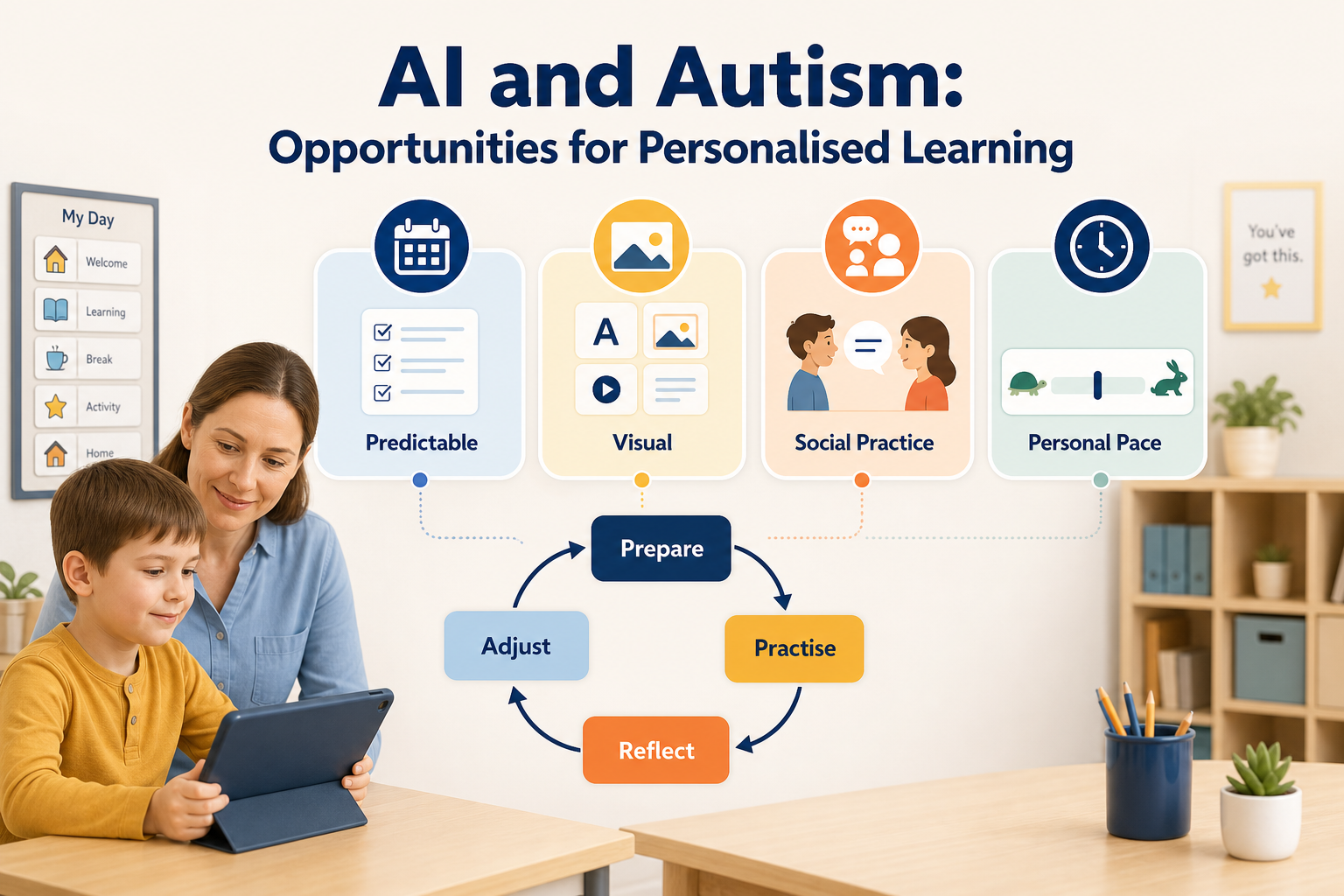
AI can support autistic learners through predictable learning environments, visual learning, social communication practice and personalised pace.
The Core Reality
In real classrooms and training settings, staff often need to adapt quickly. A learner may need a clearer routine, a visual breakdown, a calmer explanation or more time to process information.
AI can help create draft visual schedules, structured steps, role-play scripts, social stories, vocabulary lists and personalised practice tasks.
The human role remains essential because staff know the learner's preferences, triggers, strengths and communication style.
The Main Challenge
The main challenge is respectful personalisation.
Poor AI use can produce generic assumptions about autism. Good AI use starts from the individual learner: what helps this person understand, communicate, practise and progress?
Personalised learning should not mean lowering ambition. It should mean designing a route that makes learning clearer and more manageable.
Why It Happens
Difficulties often happen when learning environments rely on hidden expectations.
Unclear instructions, sudden changes, noisy group work, abstract language and unpredictable assessment tasks can create barriers. Staff may want to adapt resources but lack time.
AI can reduce preparation time, but only when staff know how to prompt and review outputs properly.
Real-World Examples
These examples show how the idea can be applied in everyday education, training and learner support practice.
Predictable learning environments
A tutor uses AI to turn a workshop into a clear agenda with timings, equipment needed and expected outcomes.
Visual learning
A trainer asks AI to create a step-by-step visual sequence for a practical task, then checks the accuracy before use.
Social communication practice
A learner practises workplace conversation scenarios generated by AI, with staff support and reflection afterwards.
Personalised pace
A learner receives the same concept broken into smaller stages with optional extension tasks when ready.
The Risks of Doing Nothing
If organisations ignore personalisation, learners may be misread as disengaged when the real issue is access, predictability or communication.
If AI is used carelessly, it may produce stereotypes, unsuitable social scripts or advice that does not match the learner's needs.
The risk is not AI itself. The risk is using it without the learner's voice, staff judgement and safeguarding awareness.
Risk to Learners
Barriers can remain hidden, support can become inconsistent, and confidence can be damaged.
Risk to Organisations
Quality, inclusion, safeguarding and assessment integrity can suffer when AI use is unmanaged.
A Better Way Forward
A better way forward is to use AI as a preparation and adaptation tool under professional oversight.
Staff can use AI to draft structured materials, visual explanations and practice scenarios, then refine them with knowledge of the learner.
Learners should be involved where appropriate, because personalisation should be done with them, not simply to them.
Who Benefits and How
Learners
gain clearer expectations, more accessible explanations and more control over pace.
Teachers
can create structured resources and scenarios more efficiently.
Organisations
can improve consistency in inclusive practice.
Peers and teams
benefit from clearer communication and better-designed learning environments.
Leadership Reflection
Leaders should ask whether their learning environments are genuinely flexible or only flexible for learners who already fit the system.
AI can support personalised learning, but the deeper work is cultural: listening to learners, designing predictable systems and valuing different ways of learning.
Key Takeaway
AI can support autistic learners through predictable learning environments, visual learning, social communication practice and personalised pace.
The strongest approach is individual, respectful and professionally reviewed.
Closing Question
How can AI help us design learning environments that are clearer, calmer and more responsive?
Reference Sources Reviewed
This article has been written as professional guidance, with factual claims checked against recognised education, accessibility and health-information sources.