How AI Can Help Learners With Dyslexia
Dyslexia does not mean a learner lacks intelligence, ideas or potential.
Opening Hook
Dyslexia does not mean a learner lacks intelligence, ideas or potential.
Often, the barrier is the way information is presented, processed or recorded.
AI can help by giving learners more routes into reading, writing and understanding.
Why This Matters
This matters because education still relies heavily on written information. Instructions, assignments, feedback, policies, revision notes and assessments often arrive as text.
For learners with dyslexia, that can create unnecessary friction. Text-to-speech, reading support, simplified explanations and writing assistance can make learning more accessible without lowering expectations.
The aim is not to make work easier in a negative sense. The aim is to remove barriers so learners can demonstrate what they know.
Key Point
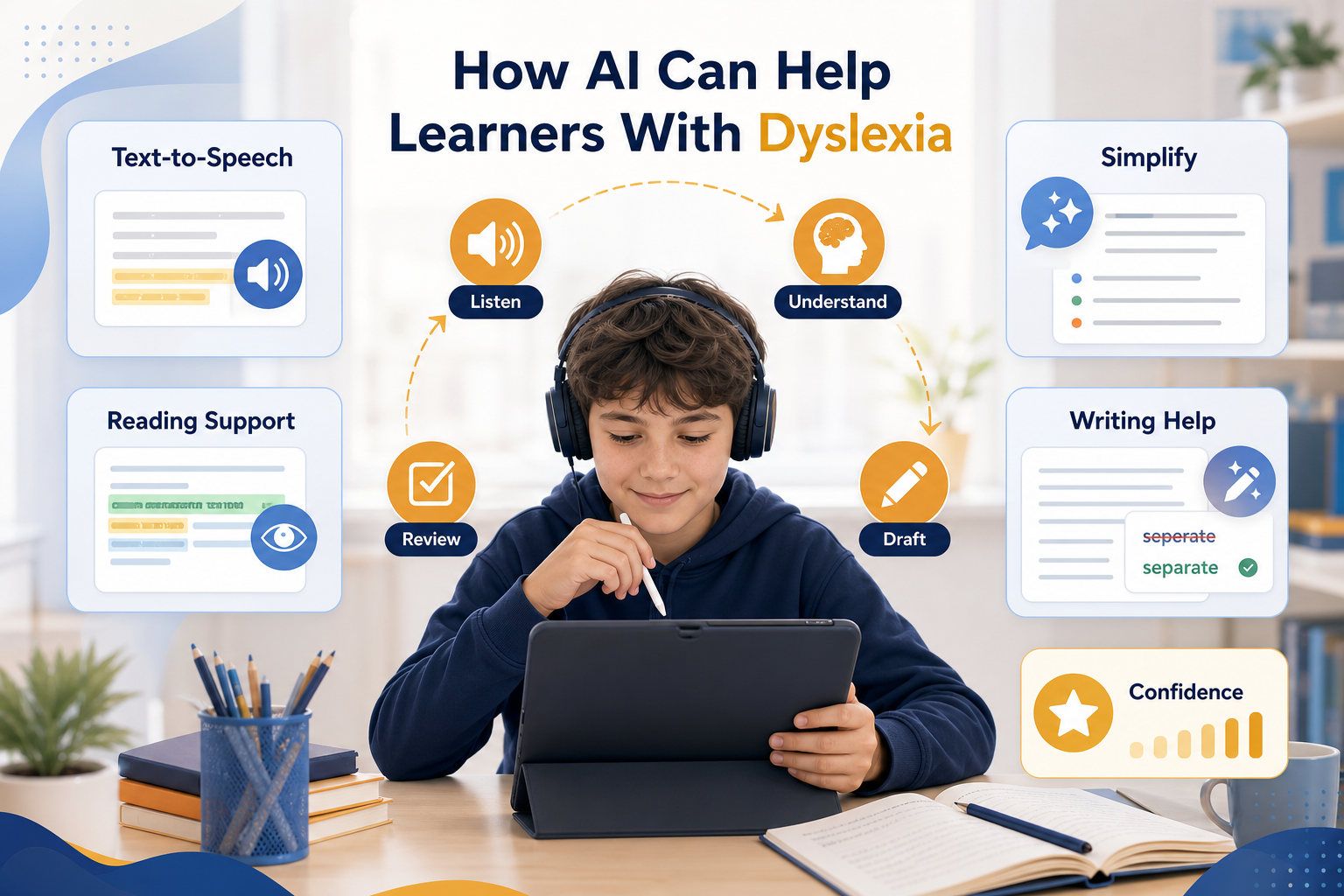
AI can help learners with dyslexia through text-to-speech, reading support, simplified explanations and writing assistance.
The Core Reality
Many learners with dyslexia develop strong strategies over time, but they may still experience fatigue, slower reading speed, spelling difficulty, sequencing challenges or reduced confidence with written tasks.
AI tools can support by reading text aloud, summarising long passages, explaining unfamiliar words, suggesting structure and helping learners check clarity.
These supports should sit alongside teaching, reasonable adjustments, assistive technology and professional assessment where required.
The Main Challenge
The main challenge is making sure AI supports the learner's thinking rather than replacing it.
A writing assistant can help organise ideas, but the learner still needs to understand the subject. A simplified explanation can support access, but it still needs to be accurate. A summary can save time, but it should not replace deeper reading where deeper reading is required.
Good support preserves the learning goal while changing the route to that goal.
Why It Happens
Problems often happen when organisations treat dyslexia support as an add-on instead of a core part of inclusive learning design.
Staff may not know which AI uses are appropriate, learners may not know how to prompt safely, and quality systems may not distinguish between legitimate support and inappropriate completion of work.
Clear guidance is essential.
Real-World Examples
These examples show how the idea can be applied in everyday education, training and learner support practice.
Text-to-speech
A learner listens to assignment instructions before starting, then highlights key action words with support from the tutor.
Reading support
AI creates a glossary of difficult terms from a course handout. The teacher checks the definitions before sharing them.
Simplified explanations
A learner asks for a complex topic to be explained using everyday examples, then discusses the explanation with a tutor.
Writing assistance
AI helps turn spoken bullet points into a draft structure. The learner edits the content and adds personal examples.
The Risks of Doing Nothing
Doing nothing can leave learners working harder to access the same content, which can affect confidence and progress.
Using AI carelessly can also create problems. If AI writes too much of the response, the evidence may no longer show the learner's competence. If outputs are not checked, learners may rely on inaccurate or oversimplified information.
Support must be transparent, ethical and proportionate.
Risk to Learners
Barriers can remain hidden, support can become inconsistent, and confidence can be damaged.
Risk to Organisations
Quality, inclusion, safeguarding and assessment integrity can suffer when AI use is unmanaged.
A Better Way Forward
A better approach is to create clear support pathways.
Organisations should identify which AI uses are acceptable for planning, reading, drafting and checking. Staff should model how to use AI prompts responsibly. Learners should be encouraged to explain how support helped them and what work remains their own.
This protects both accessibility and integrity.
Who Benefits and How
Learners
can access text in more flexible ways and build confidence in written communication.
Teachers
can provide scaffolded resources more efficiently.
Assessors
can focus on understanding and competence rather than spelling alone, where appropriate.
Organisations
can strengthen inclusive practice and consistency.
Leadership Reflection
The leadership question is whether support is being designed around learner access or added only after difficulty appears.
AI gives organisations an opportunity to make accessible practice more normal, but only if it is used with clear values and quality assurance.
Key Takeaway
AI can help learners with dyslexia through text-to-speech, reading support, simplified explanations and writing assistance.
The key is to use AI to support access, confidence and independence while protecting the authenticity of learning.
Closing Question
How can we make dyslexia support feel normal, respectful and built into everyday learning?
Reference Sources Reviewed
This article has been written as professional guidance, with factual claims checked against recognised education, accessibility and health-information sources.