How AI Can Improve Educational Inclusion
Inclusion is not only about being present in the room.
Opening Hook
Inclusion is not only about being present in the room.
It is about being able to access the learning, participate meaningfully, build confidence and show what you know.
AI could help education move closer to that standard.
Why This Matters
This matters because many barriers to learning are not immediately visible. Language, confidence, reading level, prior knowledge, disability, time, technology access and assessment design can all affect participation.
AI can support equal access by creating alternative explanations, personalised practice, translated support, reading help and confidence-building feedback.
But inclusion requires intention. AI will not automatically make education fairer unless people use it for that purpose.
Key Point
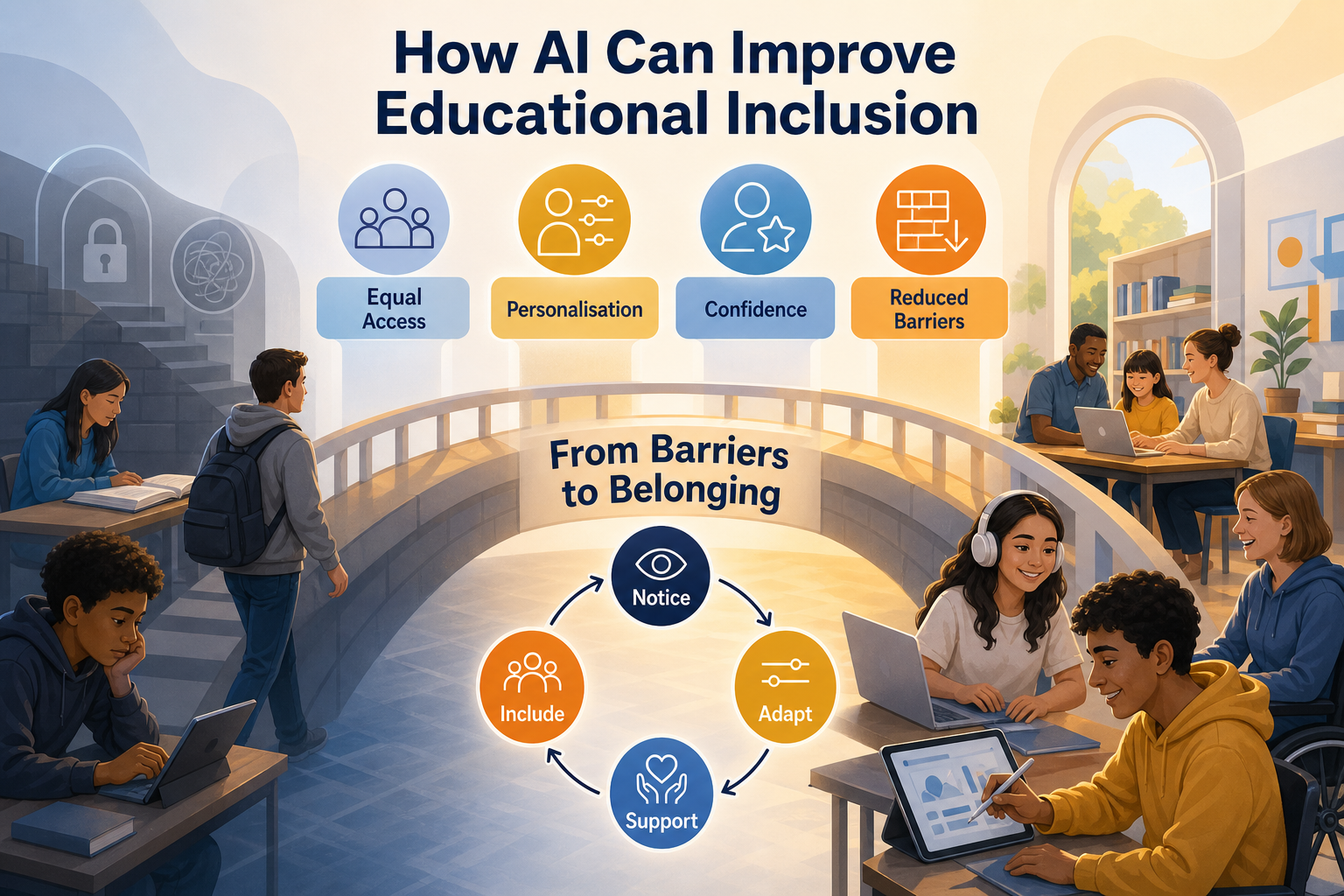
AI can improve educational inclusion through equal access, personalisation, confidence building and barrier reduction.
The Core Reality
In many settings, learners receive the same resource, the same explanation and the same assessment route even when their starting points are different.
AI can help staff adapt materials quickly and help learners ask for support privately. It can offer practice questions, simplified explanations, vocabulary support and step-by-step guidance.
This can be powerful for learners who are hesitant to ask questions or who need repeated explanation.
The Main Challenge
The main challenge is ensuring AI reduces barriers rather than creating new ones.
Learners without devices, connectivity, digital confidence or safe guidance may not benefit. Some may use AI well. Others may be excluded from the support it offers.
Educational inclusion depends on access, training and thoughtful implementation.
Why It Happens
Inclusion gaps happen when systems are designed for the average learner.
The average learner rarely exists in real life. Real learners have different histories, responsibilities, strengths, needs and confidence levels.
AI can help personalise support, but organisations must avoid assuming that personalisation is only a technical issue.
Real-World Examples
These examples show how the idea can be applied in everyday education, training and learner support practice.
Equal access
A college creates plain-language versions of key guidance while keeping the original full version available.
Personalisation
A learner receives extra examples linked to their vocational area, helping them connect theory to practice.
Confidence building
A learner uses AI to rehearse answers before contributing to a group discussion.
Reducing barriers
A tutor creates vocabulary support for learners who are new to a subject or learning in an additional language.
The Risks of Doing Nothing
If organisations ignore AI's inclusion potential, they may miss an opportunity to reduce avoidable barriers.
If they introduce AI without support, they may widen gaps between learners who know how to use it and learners who do not.
The risk is that AI becomes another advantage for those already advantaged.
Risk to Learners
Barriers can remain hidden, support can become inconsistent, and confidence can be damaged.
Risk to Organisations
Quality, inclusion, safeguarding and assessment integrity can suffer when AI use is unmanaged.
A Better Way Forward
A better way forward is to connect AI strategy with inclusion strategy.
Organisations should provide access, training, safe guidance and examples of responsible use. Staff should be supported to create inclusive resources and learners should be taught how to use AI to support understanding, not bypass learning.
Quality assurance should ask whether AI is improving access and outcomes for different learner groups.
Who Benefits and How
Learners
can access explanations, practise privately and build confidence.
Teachers
can adapt materials more quickly and respond to varied needs.
Organisations
can strengthen inclusion, learner support and quality improvement.
Society
benefits when more people can develop skills and participate fully.
Leadership Reflection
Leaders should ask who benefits first from AI in their organisation.
If the answer is only confident, well-resourced learners, the inclusion opportunity is being missed.
Key Takeaway
AI can improve educational inclusion through equal access, personalisation, confidence building and barrier reduction.
But inclusion must be designed, measured and supported.
Closing Question
How can we make sure AI reaches the learners who could benefit most from additional support?
Reference Sources Reviewed
This article has been written as professional guidance, with factual claims checked against recognised education, accessibility and health-information sources.