Can AI Help Reduce Educational Inequality?
Educational inequality is not caused by one single factor, so it will not be solved by one single technology.
Opening Hook
Educational inequality is not caused by one single factor, so it will not be solved by one single technology.
But AI may become part of the solution if it is used to widen access to explanations, practice, feedback and flexible support.
The word if is important.
Why This Matters
This matters because learners do not all have the same access to time, confidence, tutoring, resources, quiet study space, digital tools or specialist support.
AI can offer one-to-one explanations, flexible practice and low-cost learning support. It can help a learner revisit a topic after class, ask questions privately or receive another explanation when a teacher is not immediately available.
But AI can only reduce inequality if access, guidance and quality are addressed.
Key Point
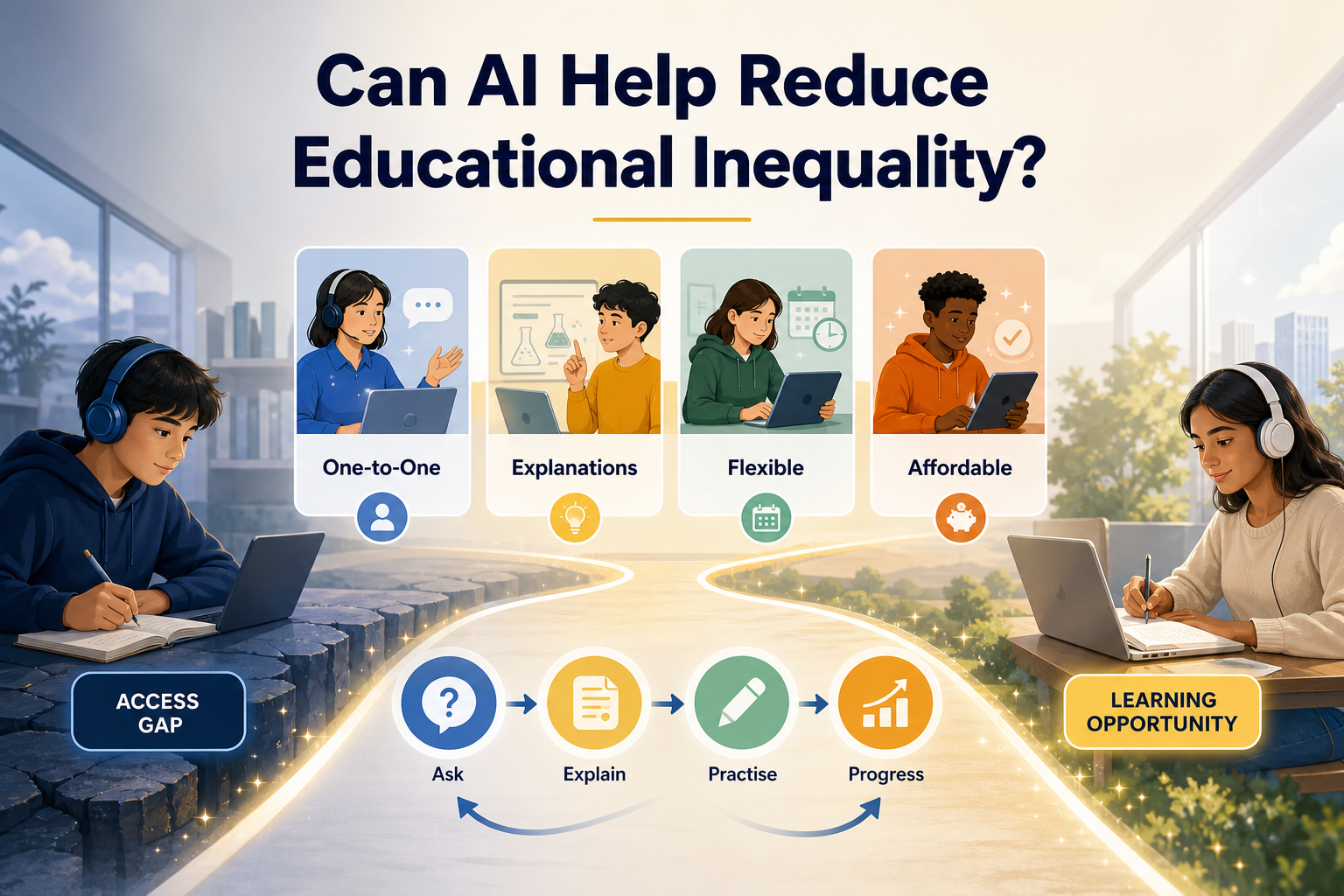
AI can help reduce educational inequality by increasing access to one-to-one support, explanations, flexible learning and cost-effective practice.
The Core Reality
Many learners need more support than the system can easily provide. Teachers and trainers cannot be available every hour of the day. Families cannot always pay for additional tutoring. Adult learners may study around work and caring responsibilities.
AI tools can provide immediate explanations, revision questions, examples and study plans. This can be valuable, especially where learners need repeated practice.
However, the quality of support depends on the tool, the prompt, the learner's digital confidence and the surrounding guidance.
The Main Challenge
The main challenge is the digital divide.
Learners who already have devices, connectivity, confidence and adult support may benefit quickly. Learners without those advantages may be left further behind.
AI does not automatically create equity. It can either reduce gaps or widen them depending on how it is introduced.
Why It Happens
Inequality grows when learning support depends too heavily on private resources.
If some learners can access tutoring, quiet space, technology and expert guidance while others cannot, outcomes are affected. AI may lower some costs, but it does not remove every barrier.
Organisations need to plan for access, training, safeguarding, quality and learner confidence.
Real-World Examples
These examples show how the idea can be applied in everyday education, training and learner support practice.
One-to-one support
A learner asks AI to explain a science concept three different ways, then checks understanding with a teacher.
Access to explanations
An adult learner studying in the evening uses AI to revisit a topic after work and prepares questions for the next session.
Flexible learning
A learner who cannot attend extra revision sessions uses AI-generated practice questions to study at a suitable time.
Cost-effective support
A community programme uses AI-supported resources to provide additional study prompts while staff focus on guidance and feedback.
The Risks of Doing Nothing
If organisations ignore AI, learners may still use it privately without guidance, increasing inconsistency and risk.
If AI is introduced without access planning, better-resourced learners may gain more benefit. If outputs are not checked, learners may receive inaccurate or shallow support.
There is also a risk that policymakers treat AI as a cheap replacement for investment in teachers, support staff and learning infrastructure. That would be a mistake.
Risk to Learners
Barriers can remain hidden, support can become inconsistent, and confidence can be damaged.
Risk to Organisations
Quality, inclusion, safeguarding and assessment integrity can suffer when AI use is unmanaged.
A Better Way Forward
A better way forward is to treat AI as part of a wider equity strategy.
Organisations should provide guided access, teach learners how to ask better questions, support staff with training and build AI use into learning support rather than leaving it to chance.
Equity-focused AI should be measured by whether learners understand more, participate more and progress with greater confidence.
Who Benefits and How
Learners
can access explanations, practice and support beyond scheduled lessons.
Teachers
can focus more time on judgement, feedback and human support.
Organisations
can extend learning support while maintaining quality standards.
Communities
benefit when more people can access skills and lifelong learning.
Leadership Reflection
The leadership question is not simply, 'Can AI reduce inequality?'
The better question is, 'What conditions would make AI reduce inequality rather than reinforce it?' That requires access, training, governance and sustained investment in people.
Key Takeaway
AI can help reduce educational inequality by increasing access to one-to-one support, explanations, flexible learning and cost-effective practice.
But technology alone is not equity. Equity comes from how technology is governed, funded, taught and supported.
Closing Question
What would need to be true in your organisation for AI to genuinely widen opportunity?
Reference Sources Reviewed
This article has been written as professional guidance, with factual claims checked against recognised education, accessibility and health-information sources.