The Hidden Learning Challenge: Understanding PTSD in Education
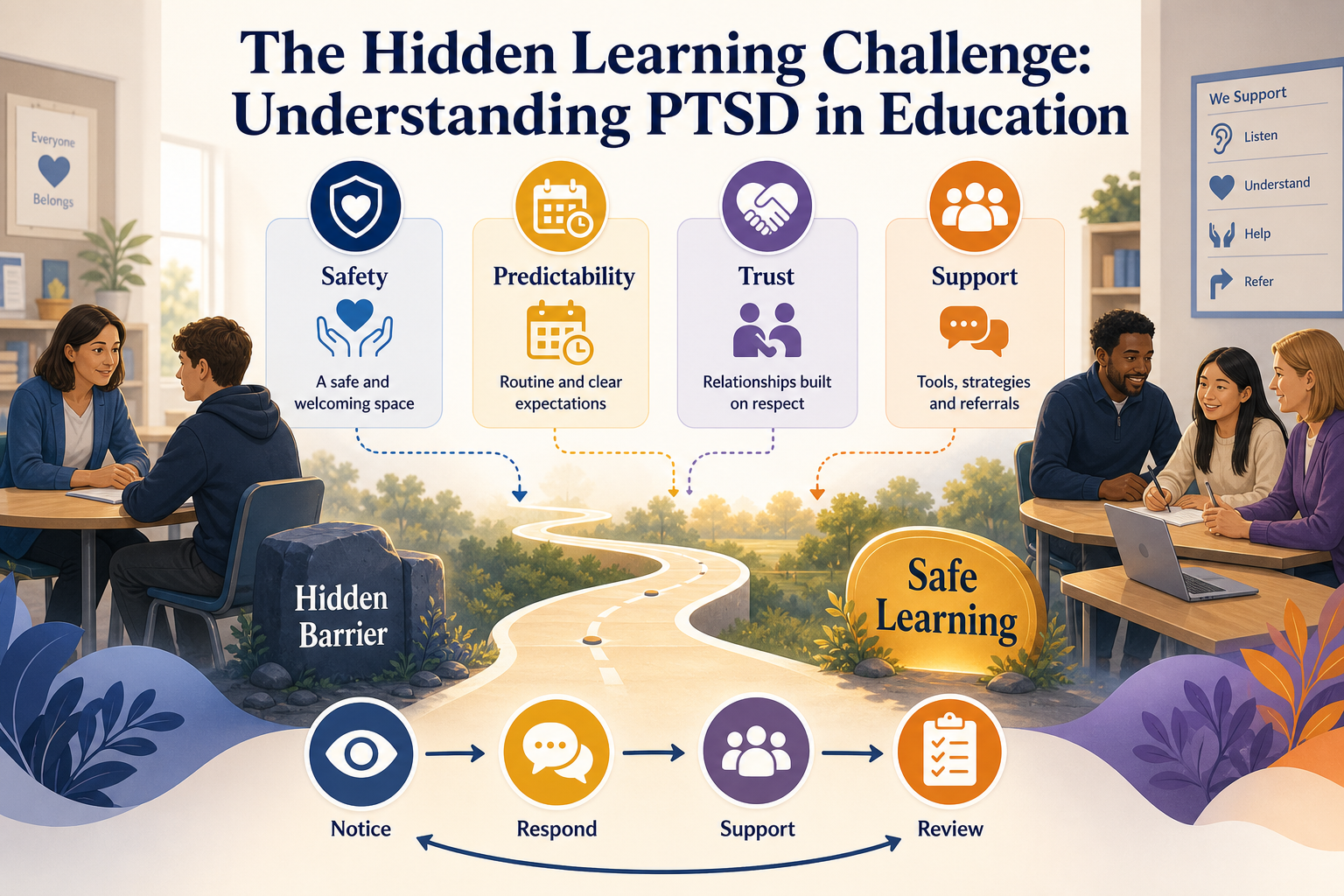
Some learners are not disengaged. They are overwhelmed. Trauma can become a hidden barrier to attention, memory, trust and participation.
Opening Hook
Some learners are not disengaged. They are overwhelmed.
Some are not being difficult. They are trying to stay emotionally safe.
Some are not avoiding learning because they do not care. They may be responding to trauma that the education system has not yet learned how to recognise.
Post-traumatic stress disorder, often shortened to PTSD, is usually discussed in clinical settings. But its impact can also appear in classrooms, colleges, training centres, apprenticeships and workplace learning.
Why This Matters
This matters because learning depends on more than curriculum, resources and assessment design. Learning also depends on safety, trust, attention, memory, confidence and emotional regulation.
When a learner is affected by trauma, the learning environment can feel unpredictable or threatening even when staff have no intention of causing harm. A raised voice, sudden change, crowded room, public questioning, assessment pressure or unexpected feedback can affect participation.
Educators are not expected to diagnose PTSD. That is a clinical role. However, education teams do need to understand that trauma can affect behaviour, concentration, attendance, communication and confidence.
A trauma-informed approach helps staff ask a better question: not simply, 'What is wrong with this learner?' but, 'What might this learner be experiencing, and how can we support learning safely?'
Key Point
Educators do not need to diagnose PTSD, but they do need to understand how trauma can affect learning and participation.
The Core Reality
PTSD can develop after very stressful, frightening or distressing events. According to the NHS, symptoms can include re-experiencing aspects of the trauma, avoidance, feeling constantly on edge, sleep problems, difficulty concentrating and changes in mood.
In education, those experiences may not be obvious. A learner may seem withdrawn, distracted, defensive, inconsistent, angry, tired or unwilling to participate. Another learner may appear highly controlled and capable, while privately struggling with anxiety, flashbacks or sleep disruption.
This is why PTSD can become a hidden learning challenge. The learner's difficulty may be interpreted as attitude, behaviour or lack of motivation when it may be connected to trauma responses.
The educational response should be calm, proportionate and supportive. Staff should follow safeguarding procedures, reasonable adjustment processes, learner support pathways and referral routes where appropriate.
The Main Challenge
The real challenge is that trauma does not always look like trauma.
In a learning environment, it may look like poor attendance, missed deadlines, emotional shutdown, avoidance of group work, difficulty with feedback, discomfort with authority figures, sudden distress, perfectionism, memory gaps or rapid changes in behaviour.
If staff respond only with discipline, pressure or repeated warnings, the learner may become more anxious and less able to engage. If staff ignore the issue entirely, the learner may remain unsupported.
The challenge is to maintain high expectations while creating conditions where the learner can access those expectations safely.
Why It Happens
This gap often happens because many education systems are designed around compliance rather than emotional safety.
Timetables, deadlines, assessments, classroom management and behaviour policies are necessary. But when they are applied without flexibility or context, they can unintentionally increase distress for some learners.
Another reason is lack of training. Staff may receive safeguarding training, but not always enough trauma-informed practice training. They may know what to do when a learner discloses harm, but feel less confident recognising how trauma can affect learning day to day.
There is also a risk of misunderstanding. Trauma-informed practice is not about removing boundaries or lowering standards. It is about using boundaries, routines and expectations in ways that are predictable, respectful and supportive.
Real-World Examples
These examples show how trauma-informed practice can protect learning without asking educators to act as clinicians.
Example 1
A learner avoids presentations and is labelled uncooperative. A trauma-informed response explores whether alternative presentation methods, preparation time or smaller audience options could allow the learner to demonstrate the same outcome.
Example 2
A learner reacts strongly to public correction. Instead of challenging the learner in front of peers, the teacher uses private feedback, calm language and clear next steps.
Example 3
A learner misses deadlines after periods of poor sleep. Support staff help create a manageable plan, check whether wider support is needed and agree realistic review points.
Example 4
A learner struggles in a noisy workshop. The provider considers seating, breaks, advance notice of activities and access to a quieter space where possible.
Example 5
In each case, the aim is not to diagnose. The aim is to notice barriers, respond safely and protect learning.
The Risks of Doing Nothing
If organisations ignore trauma as a learning issue, learners may be misunderstood, excluded or pushed further away from education.
There may be increased conflict, poor attendance, reduced achievement, disengagement, complaints and safeguarding concerns that are recognised too late.
Staff may also feel frustrated because ordinary behaviour strategies do not appear to work. Without a trauma-informed lens, teams may repeat the same responses and expect different outcomes.
The risk is not only individual. It affects inclusion, safeguarding, learner experience, quality assurance and organisational culture.
A Better Way Forward
A better way forward is to build trauma-informed practice into education systems.
This starts with staff awareness. Teams need to understand that trauma can affect attention, memory, emotional regulation and trust. They also need clear guidance on boundaries, referral routes, safeguarding and professional limits.
Learning environments should be as predictable as possible. Clear routines, advance notice of changes, respectful communication, private feedback and transparent assessment expectations can make a difference.
Choice can also help. Where appropriate, learners may benefit from options in how they prepare, practise, communicate or demonstrate learning, while still meeting the required standard.
Quality assurance should consider whether policies support inclusion and safeguarding in practice, not only on paper.
Who Benefits and How
- **Learners:** safer participation, improved confidence, more consistent engagement and clearer routes to support.
- **Teachers and trainers:** better understanding of behaviour, more effective strategies and reduced conflict.
- **Support teams:** clearer referral pathways, earlier identification of concern and more coordinated support.
- **Organisations:** stronger safeguarding culture, better inclusion, improved retention and more humane learning systems.
- **Wider communities:** more learners able to remain connected to education, skills and opportunity.
Leadership Reflection
Leaders should ask whether their organisation is prepared to recognise hidden barriers to learning.
A trauma-informed culture is not created by one policy or one training session. It is created through consistent language, predictable systems, respectful communication, staff confidence and clear support pathways.
The strategic responsibility is to make learning environments firm enough to be safe and flexible enough to be humane.
Key Takeaway
PTSD can be a hidden learning challenge because trauma may affect attention, memory, attendance, communication, confidence and emotional regulation.
Educators do not need to diagnose PTSD. But they do need to understand how trauma can affect learning and how safe, predictable, respectful practice can support participation.
The strongest educational response combines high expectations with human understanding.
Closing Question
How would our learning environments change if we treated emotional safety as part of educational quality?
Reference Sources Reviewed
This article uses recognised health and education sources while keeping the guidance educational rather than clinical.