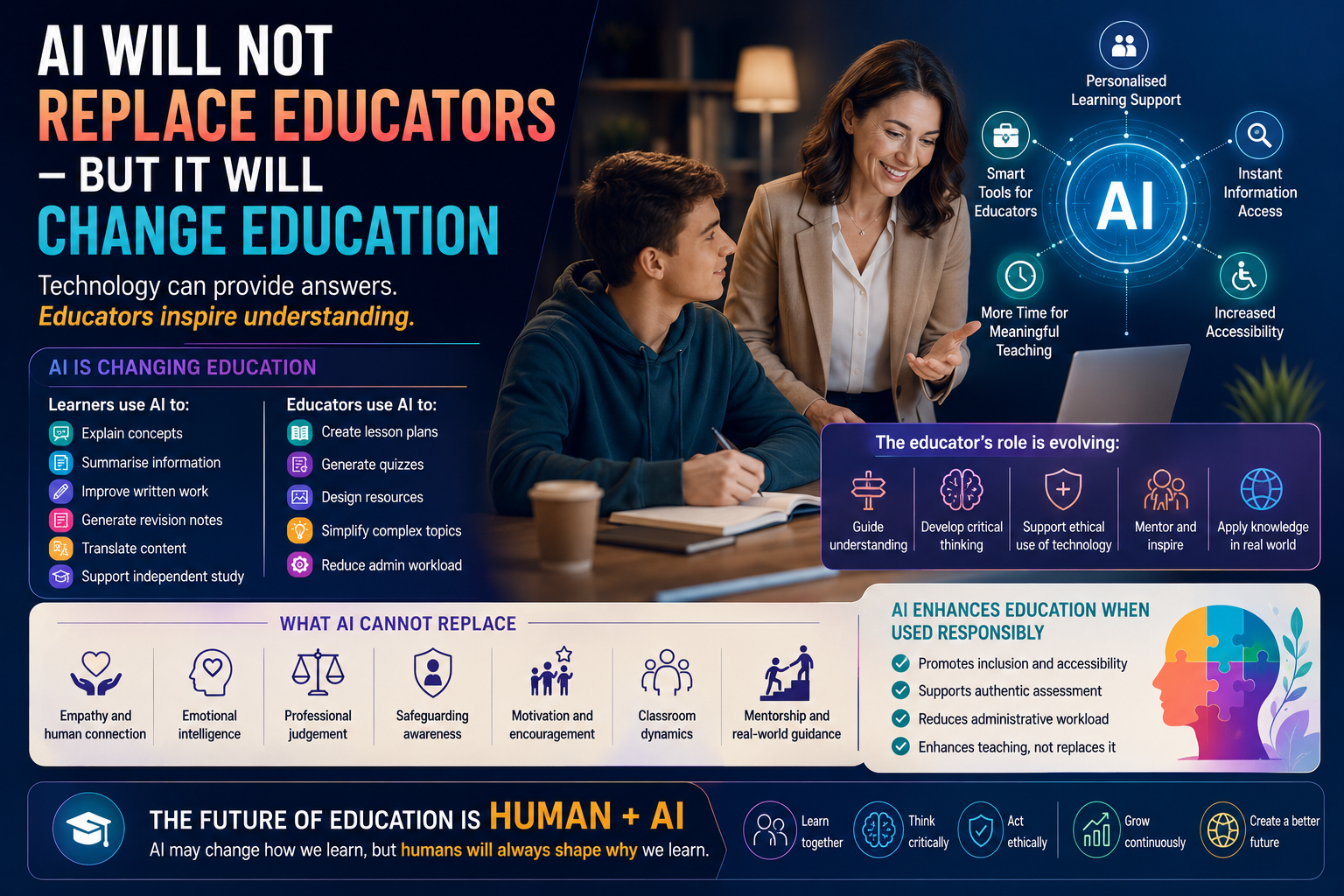
AI Will Not Replace Educators - But It Will Change Education
Technology can provide answers, automate tasks, and support learning, but meaningful education still depends on human guidance, professional judgement, empathy, mentorship, and authentic understanding.
Overview
Artificial Intelligence is becoming one of the most discussed topics in modern education. Across schools, colleges, universities, and vocational training environments, AI-powered systems such as ChatGPT, Microsoft Copilot, and Gemini are increasingly being used to support lesson planning, learner engagement, accessibility, assessment preparation, administration, and independent study.
As AI adoption continues to grow, many educators are asking an important question: will AI eventually replace teachers and educators?
While the concern is understandable, the reality is far more balanced. AI is unlikely to replace educators entirely. However, it will significantly change how education is delivered, supported, assessed, and experienced in the years ahead.
Education Is More Than Delivering Information
One of the biggest misconceptions surrounding AI is the idea that education is simply about delivering information. In reality, effective education involves far more than content delivery alone.
Great educators do not simply provide answers. They:
- motivate learners,
- build confidence,
- adapt teaching approaches,
- recognise emotional needs,
- support wellbeing,
- develop critical thinking,
- manage classroom dynamics,
- provide mentorship,
- and help learners apply knowledge within real-world situations.
These are deeply human educational skills. AI systems can generate explanations quickly, but they cannot genuinely replace empathy, emotional intelligence, safeguarding awareness, mentorship, or professional judgement.
What AI Cannot Replace
- Human connection and encouragement
- Professional judgement and safeguarding awareness
- Mentorship and ethical guidance
- Motivation and emotional support
- Real classroom and workplace interaction
- Understanding learner confidence and behaviour
How AI Is Already Changing Education
Although AI is unlikely to replace educators, it is already transforming how education operates.
How Learners Use AI
- Explaining difficult concepts
- Summarising information
- Improving written work
- Generating revision notes
- Translating content
- Supporting independent study
How Educators Use AI
- Creating lesson plans
- Generating quizzes
- Designing learning resources
- Simplifying complex topics
- Reducing administrative workload
- Supporting accessibility and inclusion
This shift changes where educators add value. The role increasingly focuses on guiding understanding, verifying accuracy, supporting ethical use of technology, developing critical thinking, and helping learners apply knowledge correctly.
In many ways, AI is shifting education away from memorisation and towards interpretation, application, reasoning, reflection, and professional judgement.
AI Can Improve Accessibility and Learner Support
AI can significantly improve accessibility when used responsibly. Learners with additional learning needs, language barriers, low confidence, or literacy challenges may benefit from AI-assisted technologies.
Language Support
Translation systems and text simplification tools can help ESOL learners understand instructions, tasks, and learning content more clearly.
Additional Learning Needs
Speech-to-text systems, text-to-speech tools, and adaptive learning systems can support learners with dyslexia or accessibility needs.
Confidence Building
Learners may privately ask AI systems for additional explanations without fear of embarrassment, helping improve participation and confidence.
These tools can create more inclusive learning environments when balanced with human guidance and safeguarding oversight.
Why Educators Remain Essential
One growing concern is over-reliance on AI-generated information. Learners may begin copying AI-generated responses without fully understanding the material being produced. AI systems may also generate inaccurate or misleading information while presenting it confidently as fact.
This is why educators remain critically important.
AI may provide information, but educators help learners:
- evaluate information critically,
- question assumptions,
- identify misinformation,
- apply ethical reasoning,
- develop professional judgement,
- and connect learning to real-life situations.
Assessment practices are also changing rapidly. Traditional written assignments alone are becoming less reliable as evidence of authentic understanding. Educators increasingly need to use:
- professional discussions,
- practical activities,
- scenario-based questioning,
- reflective learning,
- workplace observation,
- and applied assessment approaches.
This means educators are becoming even more important in maintaining authenticity, integrity, and meaningful assessment decisions.
The Future of Education Is Human + AI
AI is likely to reduce some repetitive administrative pressures that have historically contributed to educator burnout. Tasks such as lesson planning support, basic resource generation, scheduling assistance, and administrative organisation may increasingly be supported by AI systems.
If implemented responsibly, this could allow educators to spend more time focusing on:
- learner engagement,
- mentoring and coaching,
- wellbeing support,
- meaningful educational interaction,
- critical thinking development,
- and authentic learning experiences.
The future of education will probably belong to professionals who can combine technological innovation with strong human teaching, ethical judgement, learner support, and authentic educational practice.
Future-Ready Education
The most successful educational environments are unlikely to reject AI completely or rely on it excessively. Instead, they will combine human expertise with responsible AI integration.
How This Can Be Implemented in Real Life
Educational providers should focus on using AI to strengthen teaching and learning while keeping human oversight at the centre of education.
Step-by-Step Implementation Plan
- Train staff in AI literacy. Help educators understand how AI systems work, their strengths, limitations, and risks.
- Introduce responsible AI guidance. Explain acceptable AI use for learners and staff.
- Review teaching approaches. Identify where AI can support accessibility, planning, revision, and engagement.
- Strengthen authentic assessment. Add professional discussion, reflection, practical observation, and scenario-based assessment methods.
- Protect human interaction. Make sure mentoring, wellbeing support, coaching, and learner communication remain central.
- Monitor impact regularly. Review learner feedback, engagement, assessment quality, and safeguarding concerns.
What Educators Should Do
- Teach learners how to evaluate AI-generated information critically.
- Use AI to support planning, not replace professional judgement.
- Encourage ethical and transparent AI use.
- Focus on understanding rather than memorisation.
What IQAs Should Check
- Whether assessment methods remain authentic.
- Whether assessors are applying consistent judgement.
- Whether AI-related risks are included in quality assurance plans.
- Whether learners are treated fairly and inclusively.
What Providers Should Implement
- AI governance and safeguarding guidance.
- AI CPD for educators and assessors.
- Inclusive AI-supported learning strategies.
- Balanced human oversight across teaching and assessment.
Practical Example
A college introduces AI-supported revision tools for learners while also requiring professional discussion for selected assignments. Educators use AI to reduce administrative workload and generate learning resources, allowing more time for mentoring and learner support. IQAs monitor whether assessment authenticity remains strong and whether staff apply AI guidance consistently across departments.
Common Mistakes to Avoid
- Assuming AI can replace human educational judgement.
- Allowing learners to rely on AI without verifying understanding.
- Ignoring safeguarding, ethics, or inclusion.
- Using AI without staff training or clear policies.
- Focusing only on efficiency instead of meaningful learning.
Simple Action Plan
- Run one AI awareness session for staff.
- Add one AI-supported learning activity responsibly.
- Review one assessment for authenticity risks.
- Add professional discussion to selected assessments.
- Monitor learner engagement and feedback.