AI Governance in Education: Where Do We Start?
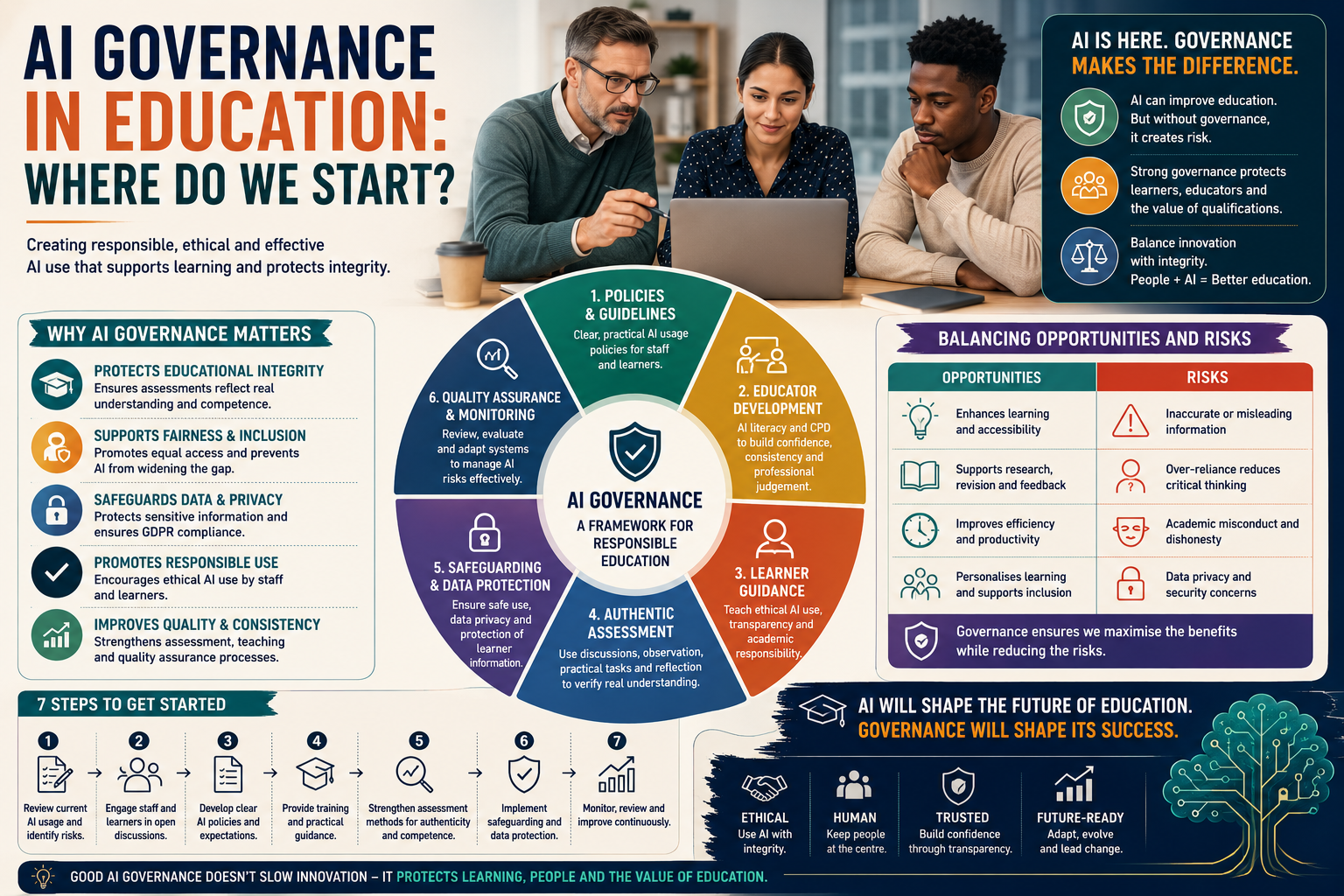
AI can improve education, but without governance it can create confusion, risk, unfairness, and weak assessment decisions. Strong governance protects learners, educators, data, and the value of qualifications.
Overview
Artificial intelligence is rapidly becoming part of everyday education. Across schools, colleges, universities, and vocational training environments, AI-powered systems such as ChatGPT, Microsoft Copilot, and Gemini are increasingly being used by learners, educators, assessors, and organisations to support learning, research, lesson planning, accessibility, administration, and assessment preparation.
However, while AI adoption is growing quickly, many educational providers are still facing one major question: how should AI actually be governed within education?
In many organisations, AI usage has developed faster than policies, staff training, learner guidance, or quality assurance processes. Some educators encourage AI use openly, others discourage it completely, and some learners use AI without understanding where support ends and misconduct begins. This inconsistency creates confusion, uncertainty, and risk.
What AI Governance Means in Education
AI governance refers to the systems, policies, procedures, and professional expectations used to ensure that AI technologies are used responsibly, ethically, fairly, and safely within educational settings.
It is not about banning technology completely. It is also not about allowing unrestricted AI use without boundaries. Effective AI governance creates a balanced approach that supports innovation while protecting:
- educational integrity,
- authentic assessment,
- learner fairness,
- data protection,
- safeguarding,
- professional standards,
- and qualification credibility.
One of the biggest mistakes providers make is assuming AI governance only relates to academic misconduct. In reality, AI governance affects teaching practice, learner support, accessibility, curriculum design, assessment, quality assurance, safeguarding, staff development, and organisational leadership.
Start with Clear Policies and Practical Guidance
A strong starting point is to develop clear AI usage policies for staff and learners. These policies should be realistic, understandable, and directly linked to the organisation's teaching, assessment, IQA, safeguarding, and data protection processes.
Without clear guidance, basic questions become difficult to answer:
- Is AI use allowed?
- What type of AI support is acceptable?
- Should learners declare AI use?
- Can AI be used for grammar support only?
- Can it be used for idea generation?
- How should authenticity be verified?
- What happens if AI-generated information is inaccurate?
Attempting to ban AI completely is unlikely to succeed long term because learners can access AI through phones, laptops, browsers, apps, and home devices. A stronger approach is to define responsible use, transparent use, and unacceptable use.
Balanced Policy Position
Providers may allow learners to use AI for revision, grammar improvement, practice questions, accessibility support, and simplified explanations, while still requiring learners to prove genuine understanding through professional discussion, practical assessment, reflective learning, and applied competence.
Staff Training Is Essential
AI governance cannot work if staff are unsure how AI operates or how it should be managed. Many educators, assessors, and IQAs are still developing confidence in this area. Without training, organisations risk inconsistent practice across departments, assessors, tutors, and qualification areas.
For example, one tutor may encourage AI use responsibly, another may treat every use of AI as misconduct, while another may rely too heavily on unreliable AI detection tools. This inconsistency damages learner trust and weakens quality assurance.
Educational providers need ongoing CPD covering:
- AI literacy,
- ethical AI use,
- assessment authenticity,
- data protection and GDPR responsibilities,
- safeguarding risks,
- AI-aware assessment design,
- and consistent assessor and IQA practice.
Governance Must Strengthen Authentic Assessment
AI governance must work alongside authentic assessment practice. The issue is not only whether learners use AI. The real question is whether the assessment system successfully verifies genuine learner understanding.
Consider a learner studying business administration who uses AI to help structure a reflective assignment. The written work appears professional, but during discussion the learner struggles to explain key ideas independently. In this situation, the problem is not simply AI use. The problem is that written evidence alone did not prove competence.
Providers increasingly need assessment methods that focus on:
- applied knowledge,
- professional judgement,
- real-world competence,
- critical thinking,
- learner engagement,
- and confident explanation.
Professional discussion, practical demonstration, workplace observation, reflective learning, and scenario-based questioning are therefore central to good AI governance. They help educators verify authentic understanding more effectively than written evidence alone.
Data Protection, Safeguarding, Fairness and Inclusion
Data Protection and Safeguarding
Many AI systems process prompts, uploaded files, user information, and interaction data. Staff and learners may unknowingly upload personal, workplace, assessment, or sensitive information into external platforms. Providers need clear guidance on safe AI use, GDPR responsibilities, confidentiality, and learner information protection.
Fairness and Inclusion
Not all learners have equal access to technology, stable internet, paid AI tools, or digital confidence. AI adoption must not increase inequality. At the same time, AI can support inclusion through translation, speech-to-text, text simplification, revision support, and personalised guidance when used responsibly.
Good governance balances opportunity with responsibility. It allows education providers to benefit from AI while controlling risks that could damage fairness, safeguarding, assessment validity, or learner trust.
How This Can Be Implemented in Real Life
AI governance should be practical, visible, and manageable. A provider does not need a perfect AI system before taking action. It needs clear starting points, consistent expectations, and a review process that improves over time.
Step-by-Step Implementation Plan
- Review current AI use. Identify how learners, assessors, tutors, administrators, and managers are already using AI.
- Create a clear AI policy. Define acceptable use, unacceptable use, declaration requirements, data protection boundaries, and assessment expectations.
- Write learner guidance. Explain AI in simple language so learners understand how to use it ethically and when to declare it.
- Deliver staff CPD. Train assessors, tutors, IQAs, and managers on AI literacy, authenticity, safeguarding, and professional judgement.
- Strengthen assessment design. Add professional discussion, scenario-based questioning, practical evidence, reflection, and observation where appropriate.
- Update IQA sampling. Add AI-related risk indicators into IQA plans, standardisation meetings, and assessor monitoring.
- Review data protection risks. Make sure staff and learners do not upload confidential or sensitive information into external AI tools.
- Monitor and improve. Review incidents, learner feedback, assessor practice, IQA findings, and policy effectiveness every term or delivery cycle.
What Assessors Should Do
- Explain AI expectations before assessment starts.
- Use professional discussion where authenticity is unclear.
- Check whether learners can explain and apply their work.
- Record judgement clearly and consistently.
What IQAs Should Check
- Whether assessment decisions are consistent across assessors.
- Whether AI risks are included in sampling plans.
- Whether professional discussions are recorded properly.
- Whether learners are treated fairly and proportionately.
What Providers Should Implement
- AI usage policy for staff and learners.
- AI CPD and standardisation sessions.
- GDPR and safeguarding guidance for AI tools.
- Clear review cycle for policy updates.
Practical Example
A training provider introduces an AI policy for learners and staff. Learners are allowed to use AI for revision, grammar support, and practice questions, but they must not submit AI-generated work as their own. Assessors add short professional discussion questions to selected assignments. IQAs update sampling plans to include AI-related authenticity risks. The provider reviews the policy after one delivery cycle using learner feedback, assessor records, IQA findings, and any malpractice concerns.
Common Mistakes to Avoid
- Creating an AI policy but not training staff on how to apply it.
- Assuming AI governance is only about plagiarism or misconduct.
- Trying to ban AI without offering realistic learner guidance.
- Using AI tools without considering GDPR, safeguarding, and confidentiality.
- Failing to update assessment and IQA processes.
Simple Action Plan
- Hold one staff discussion on current AI use.
- Draft a one-page learner AI guidance document.
- Add AI risks to the next IQA standardisation meeting.
- Select one assessment and add authenticity checks.
- Review the process after the next cohort or assessment cycle.