How AI Is Changing the Role of the IQA
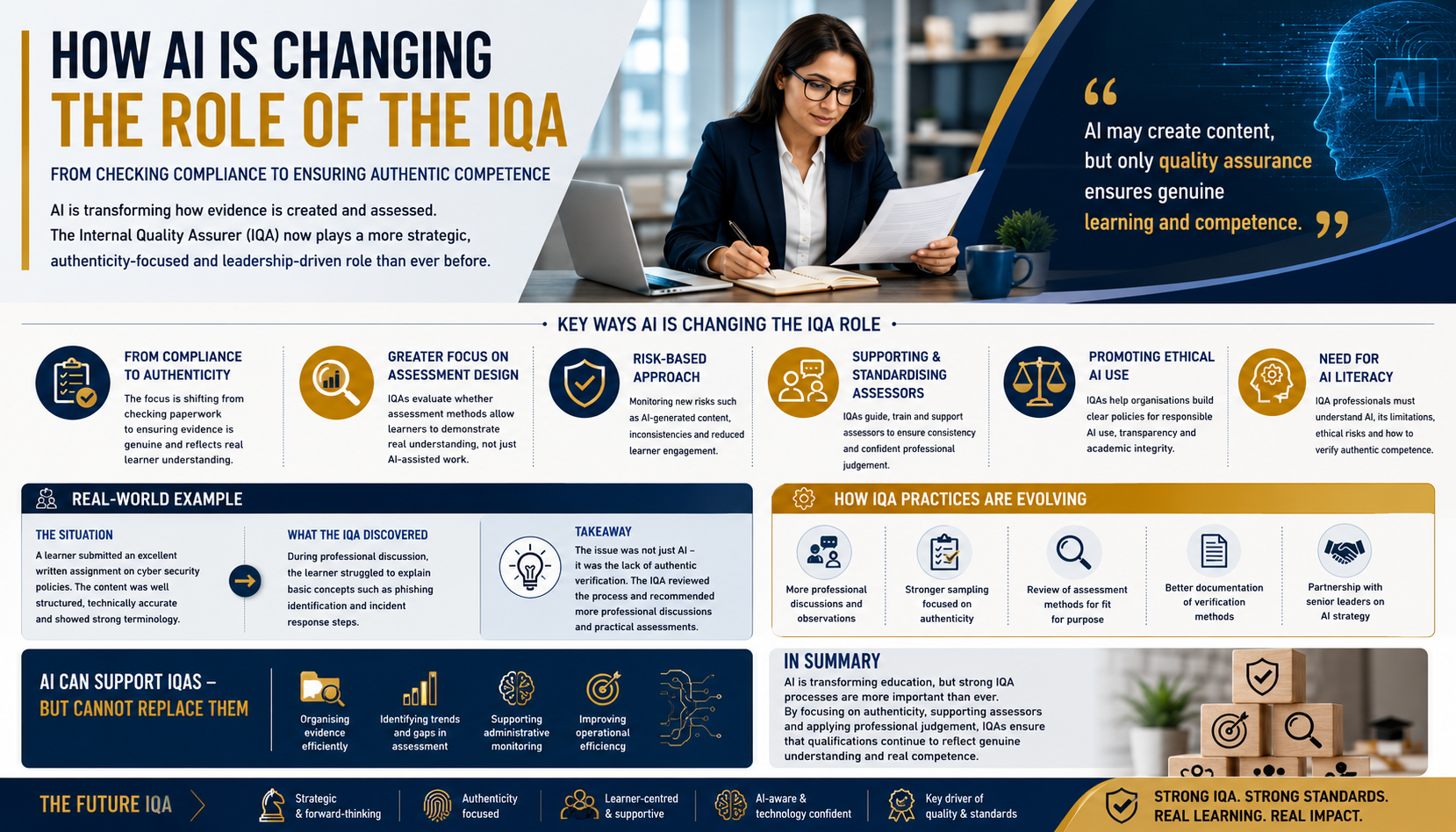
AI is transforming how evidence is created, reviewed, and assessed. Modern IQAs are becoming more strategic, authenticity-focused, and leadership-driven than ever before.
Overview
Artificial Intelligence is rapidly transforming education, assessment, and quality assurance across schools, colleges, universities, and vocational training environments. Tools such as ChatGPT, Microsoft Copilot, and Gemini are increasingly being used by learners to generate written content, improve assignments, conduct research, and support learning activities.
As a result, the role of the Internal Quality Assurer is also beginning to change significantly.
Traditionally, IQAs focused heavily on sampling assessment decisions, checking compliance, monitoring assessor consistency, reviewing documentation, and ensuring standards were maintained across qualifications.
While these responsibilities remain essential, AI-assisted education environments are creating new challenges that require IQAs to adopt broader, more strategic, and authenticity-focused roles.
From Compliance to Authenticity
One of the biggest changes affecting IQAs is the growing difficulty in verifying authentic learner evidence.
For many years, strong written work was often considered reliable evidence of learner understanding. However, generative AI has changed this environment dramatically. Learners can now produce highly polished assignments within seconds using AI support tools, even when their practical understanding may be limited.
This creates significant challenges for quality assurance processes.
For example, an assessor may submit sampled learner work that appears technically excellent on paper. The assignment may include professional terminology, clear structure, and well-developed explanations. However, during professional discussion or observation, the learner may struggle to explain:
- basic concepts,
- practical application,
- decision-making processes,
- or real-world scenarios.
In this situation, the issue is not necessarily whether AI was used. The real concern is whether the assessment process successfully verified genuine understanding and competence.
Authenticity-Focused IQA
Modern IQAs increasingly review whether assessment methods themselves remain fit for purpose within AI-assisted learning environments.
Supporting Assessors and Standardisation
Another major change involves assessor support and standardisation.
Many assessors are still developing confidence regarding how AI tools operate and how they should be managed within assessment environments. Some assessors may become overly suspicious of learner work, while others may underestimate the impact AI can have on assessment authenticity.
This creates inconsistency across teams and qualification areas.
Modern IQAs therefore play an increasingly important role in:
Assessor Support
- Supporting assessor confidence
- Providing AI-related guidance
- Helping assessors apply professional judgement consistently
- Supporting authenticity-focused assessment
Standardisation
- Reducing inconsistent practice
- Creating shared assessment expectations
- Running AI-focused standardisation meetings
- Supporting fair learner treatment
Without proper standardisation, learners may receive conflicting expectations depending on which assessor they are assigned.
AI Is Changing Risk Management
Historically, IQA sampling strategies often focused mainly on assessor performance and compliance requirements. However, modern IQAs increasingly need to monitor additional risks such as:
- over-reliance on written evidence,
- sudden changes in learner writing style,
- generic AI-generated responses,
- inconsistencies between theory and practice,
- and limited learner engagement during discussions.
Importantly, this does not mean IQAs should become “AI police.” Overly aggressive monitoring approaches can damage trust and create fear within learning environments.
Balanced professional judgement remains essential.
Effective modern quality assurance focuses on supporting authentic learning rather than simply trying to “catch AI.”
Balanced IQA Approach
- Support assessors rather than punish them
- Focus on authenticity rather than suspicion
- Review assessment design, not only learner output
- Use AI awareness alongside professional judgement
The Growing Need for AI Literacy
To maintain effective quality assurance, IQAs increasingly need to understand:
How AI Works
Understand the strengths, limitations, risks, and capabilities of generative AI systems.
Ethics and Data Protection
Understand confidentiality, GDPR responsibilities, safeguarding concerns, and ethical AI use.
Authenticity Verification
Understand how professional discussion, reflection, and practical evidence strengthen validity.
Continuous Professional Development in AI awareness is therefore becoming essential for quality assurance professionals.
At the same time, AI may also support IQAs positively in certain areas. AI-assisted systems may help organise evidence more efficiently, identify mapping gaps, support monitoring processes, analyse trends, and improve operational efficiency.
However, technology cannot replace professional IQA judgement because quality assurance still involves context, fairness, interpretation, communication, ethics, and professional understanding.
The Future IQA
The future IQA is likely to become:
- more strategic,
- more authenticity-focused,
- more learner-centred,
- more technology-aware,
- and more involved in educational leadership and governance.
Rather than focusing only on compliance, IQAs increasingly help organisations:
- adapt assessment strategies,
- manage technological change,
- support staff development,
- strengthen educational integrity,
- and maintain confidence in qualifications.
How This Can Be Implemented in Real Life
Modern IQA practice should evolve gradually and strategically rather than through fear-driven responses to AI.
Step-by-Step Implementation Plan
- Review current IQA strategies. Identify where written evidence alone may no longer sufficiently verify competence.
- Add authenticity-focused sampling. Include professional discussion, observation records, reflective evidence, and scenario-based questioning within sampling plans.
- Run AI-focused standardisation sessions. Ensure assessors apply consistent expectations and professional judgement.
- Develop AI literacy. Deliver CPD on AI capabilities, risks, ethics, safeguarding, and assessment integrity.
- Review assessment design. Evaluate whether assessments encourage application, reasoning, and authentic learner participation.
- Monitor fairness and inclusion. Ensure AI governance does not unfairly disadvantage learners.
What IQAs Should Do
- Focus on authenticity rather than paperwork alone.
- Support assessors through guidance and standardisation.
- Review whether assessment methods remain fit for purpose.
- Apply balanced professional judgement consistently.
What Assessors Should Do
- Use professional discussion appropriately.
- Verify learner understanding through application and reasoning.
- Record authenticity checks clearly.
- Maintain fair and transparent practice.
What Providers Should Implement
- AI governance policies.
- AI-focused CPD and standardisation.
- Authenticity-focused assessment strategies.
- Risk-based IQA monitoring processes.
Practical Example
An IQA reviewing cybersecurity assessment evidence notices that several learners submitted highly polished written work with similar structure and language patterns. Instead of immediately treating this as misconduct, the IQA recommends additional professional discussions and practical questioning. The discussions reveal that some learners struggle to explain real-world incident response processes. The provider then strengthens assessment design by adding more applied tasks and authenticity verification methods.
Common Mistakes to Avoid
- Focusing only on paperwork compliance.
- Becoming overly suspicious of all learner work.
- Failing to train assessors on AI-related risks.
- Ignoring authenticity verification methods.
- Using AI detection scores as automatic proof of misconduct.
Simple Action Plan
- Review one current sampling strategy.
- Add one authenticity-focused verification method.
- Run one AI standardisation discussion with assessors.
- Update CPD plans to include AI awareness.
- Monitor learner engagement and assessment consistency.