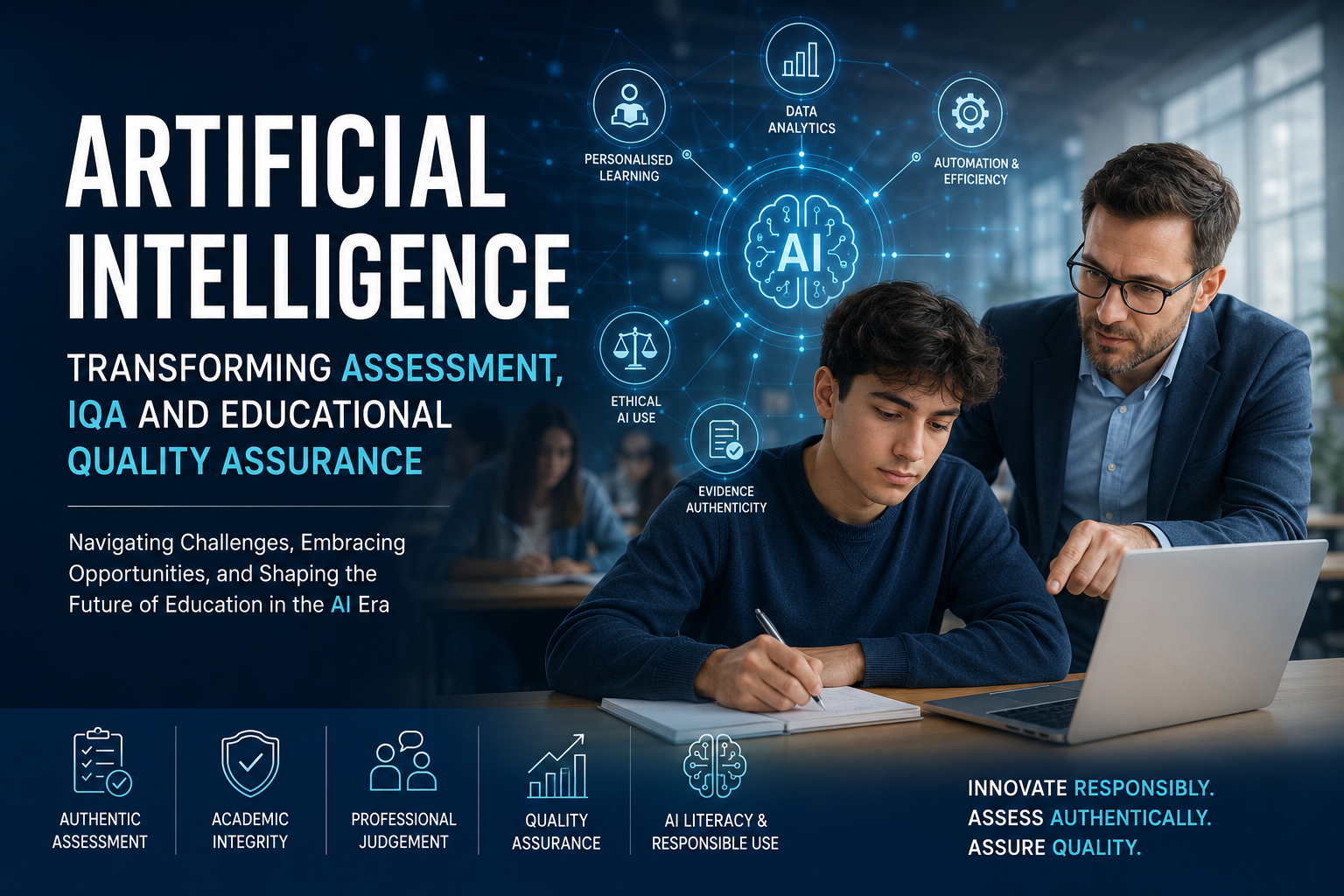
Artificial Intelligence Transforming Assessment, IQA and Educational Quality Assurance
Exploring how AI is reshaping assessment authenticity, quality assurance, learner support, professional judgement, educational governance, and the future of modern education.
The Rise of AI in Modern Education
Artificial Intelligence is rapidly transforming the global educational landscape. What was once viewed as an emerging technological innovation has now become part of everyday teaching, learning, assessment, and administrative practice across schools, colleges, universities, training providers, and professional education environments.
AI-powered systems such as ChatGPT, Microsoft Copilot, and Gemini are increasingly being used by learners, educators, assessors, and organisations to support research, generate content, improve communication, automate processes, and enhance learning experiences.
The rapid growth of generative AI has created both significant opportunities and major challenges for the education sector. AI technologies can improve accessibility, personalise learning, reduce administrative workload, strengthen learner support, and modernise educational delivery. At the same time, the rise of AI-generated content has raised serious concerns regarding academic integrity, evidence authenticity, ethical AI use, and the long-term validity of traditional assessment models.
How Learners Use AI
- Research and revision support
- Translation and accessibility
- Study notes and summaries
- Assignment planning
- Independent learning support
How Educators Use AI
- Lesson planning
- Assessment design
- Quiz creation
- Resource development
- Administrative support
Why AI Matters
- Modern workplaces already use AI
- Digital literacy is evolving into AI literacy
- Educational systems must adapt responsibly
- Professional judgement remains essential
How AI Is Changing Assessment
Assessment has traditionally been one of the central mechanisms used to measure learner understanding, competence, and academic progress. However, generative AI is fundamentally transforming how assessment must now be designed, delivered, and quality assured.
One of the most significant challenges created by AI is the growing difficulty in determining the authenticity of learner evidence. AI systems can produce highly structured and academically convincing responses within seconds.
As a result, educational providers are increasingly recognising that traditional written assessment methods alone are no longer sufficient for validating authentic learning.
The Shift Toward Authentic Assessment
- Professional discussions
- Scenario-based questioning
- Workplace observation
- Practical demonstrations
- Reflective practice
- Holistic evidence gathering
Professional discussions are becoming increasingly valuable because assessors can evaluate whether learners genuinely understand the evidence they have submitted. Follow-up questions allow assessors to explore reasoning, application, confidence, and real-world understanding.
Similarly, workplace observation remains critically important because practical performance is significantly harder to replicate artificially through AI-generated content alone.
The Impact on IQA and Internal Quality Assurance
The emergence of Artificial Intelligence within education is not only transforming assessment practices, but also significantly reshaping the role of Internal Quality Assurance.
Traditionally, IQA processes focused primarily on ensuring that assessment decisions were fair, valid, reliable, consistent, and compliant with awarding body requirements. While these responsibilities remain essential, AI-generated content has introduced a new and increasingly complex challenge: verifying the authenticity and credibility of learner evidence.
Modern IQA Focus Areas
- Evidence triangulation
- Authenticity verification
- Risk-based sampling
- Professional discussions
- Assessment design review
- Holistic evidence review
AI-Aware IQA Risks
- Sudden changes in writing style
- Generic AI-generated responses
- Over-reliance on written evidence
- Limited learner engagement
- Mismatch between theory and practice
- False positives from AI detectors
Importantly, modern IQAs are increasingly recognising that they should not become “AI police.” Overly aggressive monitoring approaches may damage trust and create fear within learning environments.
Frameworks such as holistic assessment planning, CAMERA sampling methodologies, and RAG-based monitoring systems are becoming increasingly valuable within AI-aware quality assurance environments.
Educational Quality Assurance in the AI Era
Educational quality assurance is increasingly shifting from a purely compliance-driven process toward a broader governance and integrity-based approach.
Modern quality assurance systems must now address several critical questions:
- How should AI be used ethically within education?
- What constitutes authentic learner evidence?
- How can centres maintain fairness and consistency?
- What level of AI assistance is acceptable?
- How should AI usage be disclosed?
- How can assessment validity be protected?
Key Governance Priorities
- Clear AI usage policies
- Disclosure expectations
- Data protection responsibilities
- Authenticity-focused assessment design
- AI literacy and CPD
- Ethical AI guidance
Educational providers are increasingly recognising that outright bans on AI are unlikely to succeed long term. Instead, many institutions are moving toward responsible integration frameworks where AI is used transparently, ethically, and critically.
This represents a major cultural shift within education.
Risks and Challenges of AI in Education
Authenticity Risks
- AI-generated coursework
- Weak practical competence
- Reduced independent thinking
- Assessment validity concerns
Operational Risks
- Data protection concerns
- Confidentiality breaches
- Inconsistent staff understanding
- Over-reliance on automation
Educational Risks
- Digital inequality
- Misinformation and hallucinations
- Weak critical thinking
- Unfair learner treatment
AI systems can produce inaccurate information, fabricated references, misleading explanations, and biased outputs while presenting information confidently and convincingly.
Educational institutions must therefore increasingly emphasise critical evaluation and information verification skills as part of modern digital and AI literacy.
Opportunities and Positive Transformation Through AI
Artificial Intelligence is not inherently harmful to education. When implemented responsibly, it has the potential to improve accessibility, strengthen learner support, reduce administrative burden, enhance personalisation, and modernise quality assurance systems.
Positive Educational Opportunities
- Personalised learning support
- Improved accessibility
- Independent learning support
- Operational efficiency
- Assessment mapping analysis
- Improved learner engagement
Future Skills Development
- AI literacy
- Critical evaluation skills
- Responsible digital behaviour
- Ethical awareness
- Information verification
- Professional accountability
Educational institutions therefore have an important responsibility to prepare learners not only to use AI tools, but also to understand AI limitations, ethical responsibilities, information verification, and responsible digital practice.
The most successful educational organisations in the future are likely to be those that combine technological innovation with strong governance, authentic assessment practices, and learner-centred quality assurance systems.
The Future of Assessment and Quality Assurance
The future of assessment is likely to move away from models that rely heavily on information reproduction and toward approaches that focus more strongly on applied competence, critical thinking, professional judgement, and real-world performance.
The Future Assessment Model
- Authentic assessment
- Applied problem solving
- Reflective practice
- Scenario-based learning
- Professional discussions
- Workplace competence
- Ethical reasoning
- Real-world application
Future quality assurance frameworks are also likely to incorporate:
- AI governance policies
- Authenticity verification processes
- Risk-based sampling strategies
- AI literacy requirements
- Digital integrity frameworks
- Enhanced standardisation systems
Importantly, the future of education is unlikely to involve AI replacing educators entirely. Instead, educational professionals will adapt their roles in response to technological change while continuing to provide mentorship, communication, contextual understanding, and ethical leadership.
How Educational Providers Can Implement This in Real Life
Educational organisations should approach AI strategically rather than reactively. Responsible implementation requires governance, staff development, authentic assessment design, and balanced quality assurance systems.
Step-by-Step Implementation Plan
- Create AI governance policies. Clearly define acceptable AI use, disclosure requirements, and authenticity expectations.
- Review current assessment methods. Identify where written evidence alone may no longer sufficiently verify competence.
- Increase authentic assessment methods. Expand professional discussions, workplace observations, reflective practice, and practical demonstrations.
- Train assessors and IQAs. Deliver AI-focused CPD covering ethics, risks, governance, and authenticity verification.
- Strengthen standardisation. Run AI-aware standardisation meetings to ensure consistency across teams.
- Implement risk-based IQA monitoring. Focus sampling on authenticity, engagement, and evidence triangulation.
- Promote responsible AI literacy. Teach learners how to use AI ethically, critically, and transparently.
What Assessors Should Do
- Use professional discussions regularly
- Verify learner understanding
- Review practical application
- Use contextual questioning
- Maintain fairness and consistency
What IQAs Should Do
- Monitor authenticity risks
- Support assessor confidence
- Strengthen standardisation
- Promote balanced professional judgement
- Review assessment validity
What Providers Should Implement
- AI governance frameworks
- CPD and AI literacy training
- Authentic assessment models
- Risk-based quality assurance
- Transparent AI policies
Practical Example
A vocational training provider notices that learner assignments across several units are becoming increasingly polished and technically advanced. Instead of relying on AI detection software alone, the provider strengthens professional discussions, observation activities, and reflective questioning. IQAs introduce more authenticity-focused sampling while assessors redesign assessments to require real-world application and scenario-based reasoning. As a result, the organisation improves confidence in learner competence while still allowing responsible AI-supported learning.
Common Mistakes to Avoid
- Attempting to ban AI entirely without realistic alternatives.
- Relying solely on AI detection software.
- Ignoring staff CPD and AI literacy.
- Using written evidence alone as proof of competence.
- Creating fear-driven assessment environments.
- Failing to implement clear governance policies.
Simple Action Checklist
- Review one assessment strategy this month.
- Add one authenticity-focused verification method.
- Run one AI standardisation session.
- Update one policy regarding AI usage.
- Deliver one AI-awareness CPD activity.